

Five years after launching this blog, I’m stoked that Young Money: A Field Guide to Wealth and Purpose in Your Twenties, is finally available for purchase! Buy your copy below:
There was, I believe, a time where the publishers, as well as a select few networks, magazines, and newspapers, could move the needle on a book. When there are five national newspapers, two relevant late night shows, and a handful of magazines that really matter, all it takes is one editor or journalist to care about your work and, suddenly, everyone cares about your work.
Publishers would identify and partner with talent, then they would work their network connections to get said talent’s work on the biggest stage possible. The artist’s job was to create. The publisher’s job was to platform the artist.
The internet changed that.
Suddenly, five national newspapers, two relevant late night shows, and a handful of magazines that really matter gave way to thousands of micro-blogging sites and web forums. Attention, which previously coalesced around a few central networks, was decentralized across the web. Still, I would argue that the early internet benefited many writers and creators: you could now build your own blog, forum, or some other platform to aggregate attention from like-minded individuals, and you owned the real estate.
Then social media really changed that.
Suddenly, a thousand different fiefdoms, from pickup artist chatrooms to weightlifting forums to personal cooking blogs, gave way to the “newsfeed.” A web of a million nodes collapsed to a new set of centralized platforms. But unlike the earlier regime, where Howard Stern, Oprah, The New York Times, and The Wall Street Journal, CBS, and ABC determined the storylines that we all cared about, “the newsfeed,” which became the de facto interface of Facebook and Twitter, was a never-ending carousel of “new thing” after “new thing.” You could build on top of the carousel, of course, but you never owned the carousel, and you never controlled the carousel. And as the carousel shifted away from follower-first content to algorithmically-driven content, you couldn’t be sure that your “followers” would see your content.
This, of course, led to what would become “trend-hacking,” where savvy marketers would chase and exploit hot “social media trends” to capture fickle attention before the game inevitably changed again.
And now, AI has only accelerated the discoverability challenge first introduced by the newsfeed. While an algorithmically-driven newsfeed dilutes the connection between the follower and the followed, the act of “creation” did, until ~two years ago, require effort on behalf of someone. Writing a blog post, even a “bad” blog post, took time. So did making a video, or simply engaging with folks in the replies.
But now you can just voice-to-text some rambled thoughts to ChatGPT / Claude / Grok and ask your favorite LLM to “craft an attention-grabbing LinkedIn post on this topic,” and 30 seconds later, you can pollute the newsfeed with your ClaudeSlop. And, of course, in the age of “building personal brands” where “everyone wants to be an influencer,” there are plenty of incentives to use AI to accelerate your content throughput, which means that other folks, competing for the same attention, will also leverage AI to accelerate their content throughput, which means the sheer amount of “content” being produced is growing exponentially.
But our capacity to digest “content” hasn’t grown. Whether the number of new social media posts per day is in the thousands, millions, billions, or trillions, humans only have 24 hours, a subset of which can be spend focusing on any particular “thing” online. Combine this onslaught of “slop” with a decentralized internet where my newsfeed is different from your newsfeed is different from our mutual friend’s newsfeed, and breaking through the noise is harder than ever.
40 years ago, the artist’s job was to create, and the publisher’s job was to platform the artist. In 2026, the artist must both create and platform themselves. A publisher cannot, on their own, “platform” a promising artist in 2026 because attention is no longer centralized. There’s no single “show” or “publication” that, upon covering your work, will lead to you being “GOATed.”
No, in 2026, you, the artist, must somehow convince some subsection of the internet to care about what you have to say. But how could another endpoint in the metaverse possibly care about what you have to say if they’ve never heard of you in the first place?
The artist, therefore, must now fulfill three roles.
Can you make your work known?
Can you make those who know your work care?
Can you make something worth caring about?
Writing a book is hard. It’s a year-long, mental wrestling match with yourself. You finish a chapter, take a deep breath, and another blank pages taunts you. “50,000 words to go. Good luck.” Of course, you’ll have to revise the prior chapter another 10 times, but you can deal with that later. For now, it’s on to the next one. And you do this over, and over again. You read the same words several dozen times, to the point you can’t possibly tell if it’s even “good” or not. And you don’t know if you can trust friends who read early samples, because would they really tell you if your writing sucked? And you’re stuck in this loop for a year.
Candidly, I underestimated just how difficult it would be, and I understand why the vast majority of books, particularly nonfiction books, are written by ghostwriters. It’s tough.
The nice thing about book advances, however, is that they create a powerful forcing function for actually writing a book. Something about receiving money that’s subject to being contractually clawed back should you fail to turn in a manuscript is quite motivating, particularly after you spend part of your first advance payment on a new watch. And then, upon turning in that manuscript, you unlock the rest of that advance, which is, of course, quite nice. When I first saw that book advances pay out in tranches, I was confused. “It’s an ‘advance.’ Shouldn’t I get it all up front?” Now, I think tranches make a lot of sense. Give enough money upfront that the author feels some reward (and understands the stakes of having to pay it back if they can’t deliver), backload the rest as an incentive to actually turn in the work.
But I think some writers misunderstand the purpose of the “book advance.”
There’s a romanticized view that I imagine some folks hold of the author as an “artist,” and the advance is a patronage to support this artist’s endeavors. “Here are dollars for your labor.” But that’s an incomplete understanding. While, yes, the author does keep their advance assuming that they turn in their completed work, that advance is, really, an investment from the publisher. “Here’s some money to write a book, we expect to earn that money back, and then some, from the eventual sales that result.”
A joke I’ve made a few times now that’s actually not at all a joke is that the relationship between publisher and author is akin to that of venture capitalist and founder, which is, of course, ironic, given that I sit in the “receive capital” seat as an author and the “invest capital” seat as a VC.
Early-stage venture capitalists might invest in 40 companies per fund, knowing that 50% will be 0s, 30% will return their original capital, 25% will make “some” money, and 5% will generate 90%+ of your returns. Power laws dominate the venture capital game. But they also dominate the publishing game.
Depending on the fee split, Avery Publishing has probably made $150 million+ from Atomic Habits alone since it was published in 2018, likely dwarfing the rest of its portfolio combined. Avery likely has dozens, if not hundreds of books, that cap out at a few thousand sales. But it doesn’t matter. Atomic Habits will make them millions of dollars every year, forever.
Books with early traction (not to be confused with the gamified “book launch” playbook so many folks run with shadow bulk buys to game the NYT ratings, where 50,000 books are purchased but never-once opened) that experience a “virality loop,” where enough early readers tell other folks about it to the point that the book remains popular beyond it’s initial launch window, gain “staying power” that increases with each launch cycle that the particular book survives. Put simply, books are subject to the “Lindy Effect.” The future relevancy of a book is proportional to how long it has remained relevant.
Atomic Habits will always be a best-seller because it’s always been a best-seller. The same is true for The Psychology of Money, The Subtle Art of Not Giving a F*ck, 48 Laws of Power, and other books that remain at the top of the best-sellers list year after year. Ironically, I think the slopification of the internet benefits proven winners at the expense of new releases. Why? A couple of reasons.
First, readers have information overload. When you’re bombarded with billions of inputs vying for your attention, you’ll default to the “proven thing” that minimizes your own cognitive load. If you look for best personal finance books on Amazon and see The Psychology of Money, and you remember hearing a few folks recommend it on a podcast two years ago, you’ll buy The Psychology of Money. Why waste time looking further down the list.
Second, LLMs are becoming society’s primary information retrieval vector. LLMs, which were largely trained on internet data, tend to refer readers to those books which appear to have appealed to readers asking similar questions. Therefore the best-sellers in particular categories will be pushed out as responses to new prompts over, and over, and over again. Remember, the LLMs haven’t “read” the books, they’re pattern matching on their training data. AI is a flywheel for proven winners and a roadblock for new entrants.
Back to book advances.
Advances are investments, that, granted, the author keeps regardless of the book’s ultimate performance, and they do help subsidize the author’s life as they work on the book. But publishers give authors advances with the expectation that some of their books will become perennial sellers, like Atomic Habits, more than paying back the investments not recouped from other books that underperformed.
While, as a VC, we don’t expect every founder and portfolio company to make us money, we invest in a founder reasonably believing that they will work very hard to build a big business, and, if they succeed, both parties benefit and make bank.
I don’t think a lot of writers look at the book process this way, because I think they have an archaic view of the publisher / author dynamic. If you still believe that the sole job of the author is to create something great, and that if your “thing” is great enough, some combination of publisher efforts and the broader universe recognizing your greatness will reward you with book sales… I have some waterfront property in Kansas to sell you.
The goal of the writer is the write something worth caring about, yes. Of course. That’s never changed. But you also have to convince people that you wrote something worth caring about, and to do that, you have to show people that you’ve written something worth caring about. Which, yes, means that you have to market your book. You have to hustle. Every job, at the end of the day, is a sales job. That’s especially true in the arts, though I think many artists view themselves “above” sales. “I spent my time and effort building something great, shouldn’t people just buy and appreciate it?” But that’s not how the world works. That’s not how the world has ever worked. Taking an aristocratic view of the world might make you feel “above” the hustle, but it won’t translate to book sales.
There’s a reason that companies have sales teams and engineering teams, and the top sales talent out-earn everyone else at the company: someone has to convince someone to buy your B2B SaaS, I can assure you that no one gives a shit about your agentic harness or model orchestration, but a good sales rep can change that.
The writer, unlike a company, has to both build the product and sell it. Which I’m fine with. My perspective on this is simple: someone gave me money to write a book with the implied expectation that some of the books they invest in will make them money. I would like to hold up my end of the bet and deliver, or at least give my best effort to do so.
Five years after launching this blog, I’m stoked that Young Money: A Field Guide to Wealth and Purpose in Your Twenties, is finally available for purchase! Buy your copy here.
If you aren’t working as hard to sell your book as you did to write it, you’re leaving chips on the table, and you’re treating a publisher’s advance as a patronage you were owed rather than an investment that you can leverage.
My perspective is that if you call yourself a “writer,” and you’ve poured year(s) of your life into a creative project, and that project is now complete, and you’re proud of that project, you are doing yourself a disservice by not pouring all of your efforts into giving that project maximum exposure. I have a few thoughts on why writers hesitate to promote their work.
Perhaps they find “marketing tactics” to be gauche, tacky, or insincere. This is, of course, stupid. Marketing always has been, and always will be, a crucial ingredient for success in any domain, and this is particularly true in the arts. But also, one year later, no one is going to care about your “marketing tactics.” They’ll just see the sales numbers and reviews.
I also think some folks, particularly introverted folks, hate “bothering people” about their work. To this I say that if you’ve spent hundreds, if not thousands, of hours, refining your project, you owe it to yourself to tell everyone you know about that project. It’s an act of disrespect to the work you put in to not knock down people’s doors to have them read your book, listen to your song, or watch your film. You’re worried about “bothering people” to the point you won’t send them a text or email? At worst, they won’t reply. At best, they might be moved by your creation, they might feel that you encapsulated an idea they had always felt but could never put into words, that they’ll thank you and refer your work to 100 others. And you never know which individual your work will truly resonate with. By not aggressively marketing your work, you’re depriving someone who needed to read it because of your fear of “bothering” someone who will glance at your text for two seconds before continuing on with their day.
Self-promotion of one’s work is an asymmetrical bet: no one is going to be “mad” that you “bothered” them by sharing your work. Do you realize that most people think caring is cool? Seeing someone so fired up about their thing that they can’t shut up about it is inspiring, even if I couldn’t care less about their particular thing. If you can’t be bothered to tell the world about your creation, why the hell should anyone else care enough to read it? You don’t know who needs to read what you wrote, but if you truly believe that there is a group of people who would benefit from your work, it’s your responsibility to maximize the surface area by which they can discover it.
But I think the real reason folks don’t take marketing as seriously as the creative process itself is that they’re hedging. When you spend year, after year, working on a particular thing, and it’s done, your identity becomes tied up in that thing. You likely think more, or less, of yourself depending on on the success, or failure, of that thing.
By not going all-out on marketing, you maintain a layer of self-preservation. If the book doesn’t become a best-seller, it's not necessarily because the book was “bad.” You can tell yourself that the algorithms were just working against you, or the “best-sellers” were all fake, anyway. Just a bunch of bulk orders orchestrated by “authors” with money! Ironic detachment becomes self-medication. By not committing to promotion of your work, you avoid rejection.
The artist who refuses to promote their work is like the 25-year-old guy at the bar who hesitates to approach the cute girl across the room: you withhold effort because effort makes you vulnerable to rejection. But lack of effort doesn’t protect you from rejection, it simply ensures that you remain in the same place that rejection would send you. If you don’t approach the girl, you won’t go out with the girl. If you do approach the girl, you might get curved, or you might go out with the girl. The future is uncertain, but it’s only the risk-taker who has a chance to reap the rewards.
If you don’t promote your work, your work won’t be rejected. But it won’t be accepted, or even acknowledged, because no one will know about your work. You are cementing your own irrelevance, which, again, if you’ve spent years working on thing, seems like an act of disrespect to yourself and your publisher.
But don’t get me wrong, I get it. My book came out last Tuesday. I was quite, quite anxious before launch. What if no one cares? What if it sucks? How do I even know if it’s good, at this point? But I wrote something that, to me, mattered. And my bet was that there were other people like my who would feel similarly, and it was my job to help them discover what I wrote. So I’ve been on a self-promotion tear.
I sent out more than 100 early copies to different folks with their own platforms who I thought would appreciate, and resonate, with my work. Many of them read my book. Some didn’t. But some portion of those folks who did read what I wrote loved it. You can tell, from when someone talks about your work online, if they endorsing my book because they “like Jack” and want to support (which, of course, I appreciate), and when my book really, really, resonated with them. And it’s only going to be some minority of folks with whom any particular work will truly resonate. You have to find the right person at a time in their life where a particular paragraph or passage really hits. But when you find those nodes, And they feel moved by your work to the point that they leverage their own platform and reputation to promote your work, the ripple effects are exponential. A couple of examples from my launch:
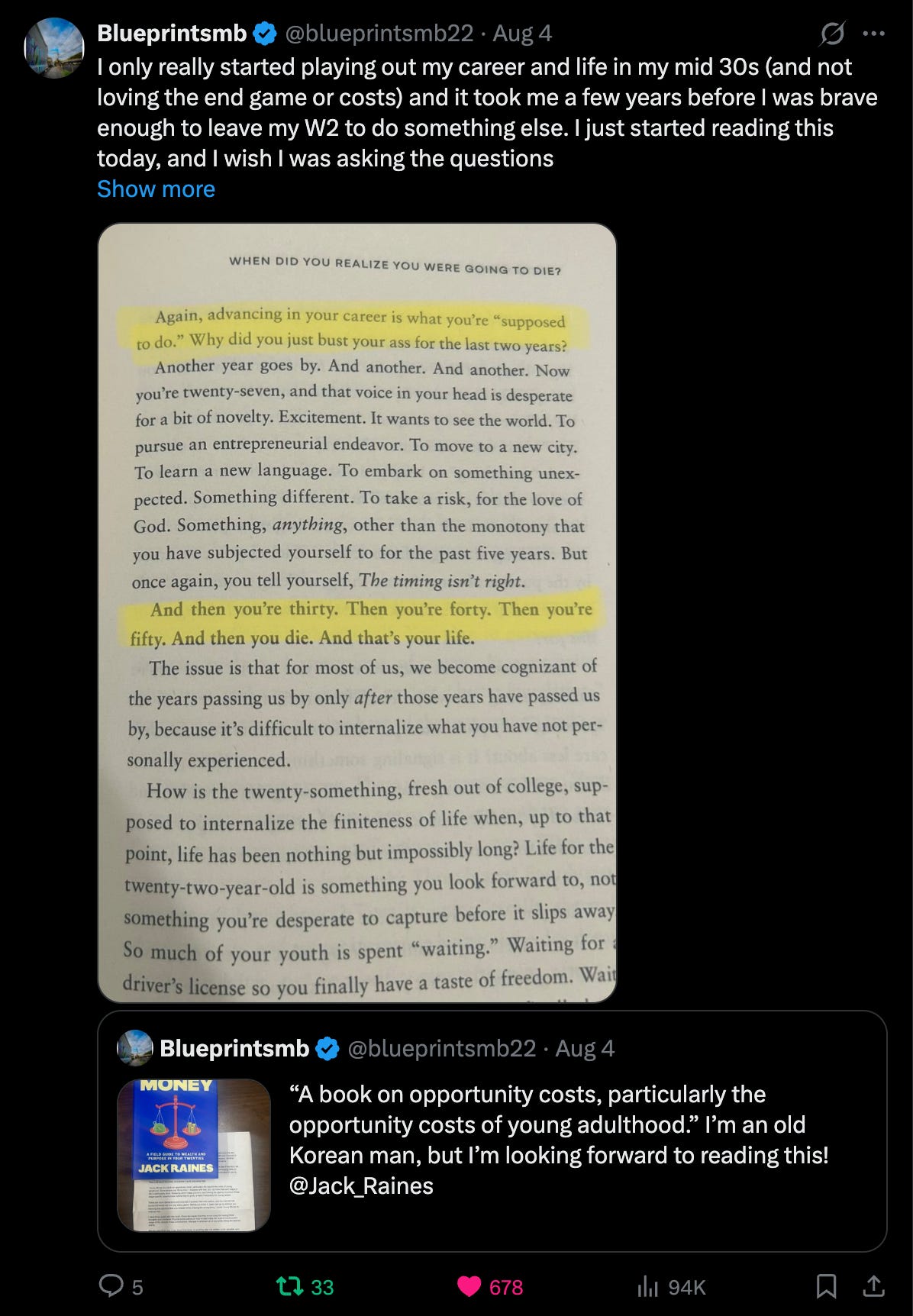
I sent an early copy to an anonymous Twitter account, “Blueprintsmb” that I quite like. He has ~20k followers. Not a huge audience, but a decent size. But he has a great story: Korean guy who grew up poor in Kansas, made his way to Wall Street, made some in the hedge fund game, burned out in his late 30s / early 40s, bought a manufacturing business in New Jersey, and now tweets about his lessons learned on Wall Street and as an entrepreneur, and how he thinks about the life tradeoffs of high-stress, high-pay W-2 work vs. running your own business. I’ve never met this guy, but we’ve DM’d a few times. He has now tweeted about my book several times, unprompted by me, to the tune of 100s of thousands of views, and many of his followers are my target demo:
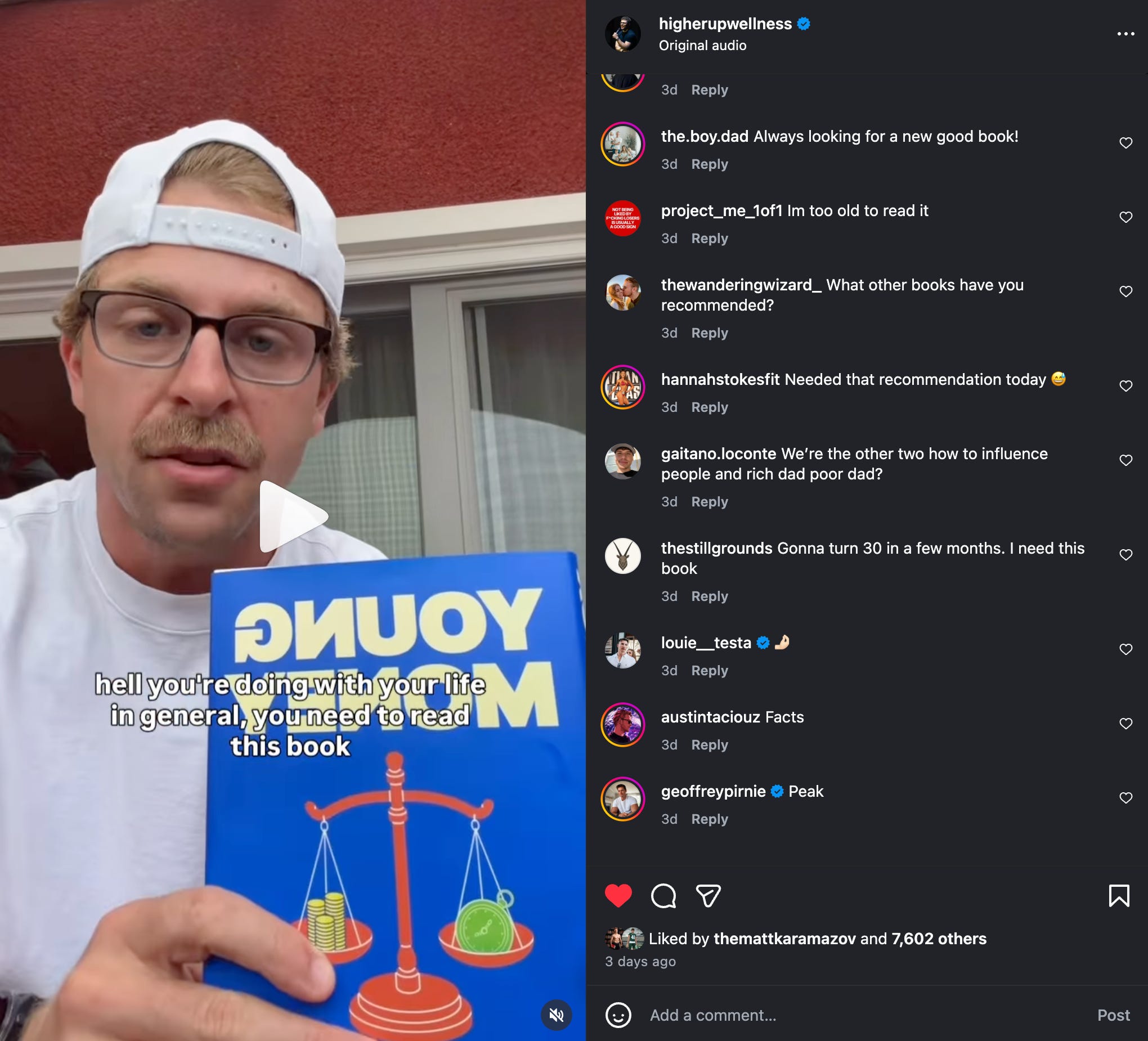
Another example is my buddy Michael Smoak. Smoak has amassed an insane following: several million folks across TikTok and Instagram under his handle “higherupwellness.” His content is a mix of fitness and broader life advice for younger folks, and he has increasingly leaned into the latter. Like with everyone I sent early copies to, I was hoping for some sort of repost or story shout out, but he actually dug into the book, loved it (we were texting back and forth about the opening chapter as he was reading it), and then published a full video on Instagram and TikTok endorsing the book, generating hundreds of thousands of views.
Again, I had no idea which folks I sent early copies to would love it, endorse it, repost something generic about it, or totally ignore it. That’s true of marketing quite literally anything. But guess what? Some of those folks did love it, they endorsed it, and my surface area grew accordingly. And a couple of days post-publication, the validation started rolling in.
There are a few people I personally DM’d or emailed after reading their books to express my appreciation. A couple of examples:
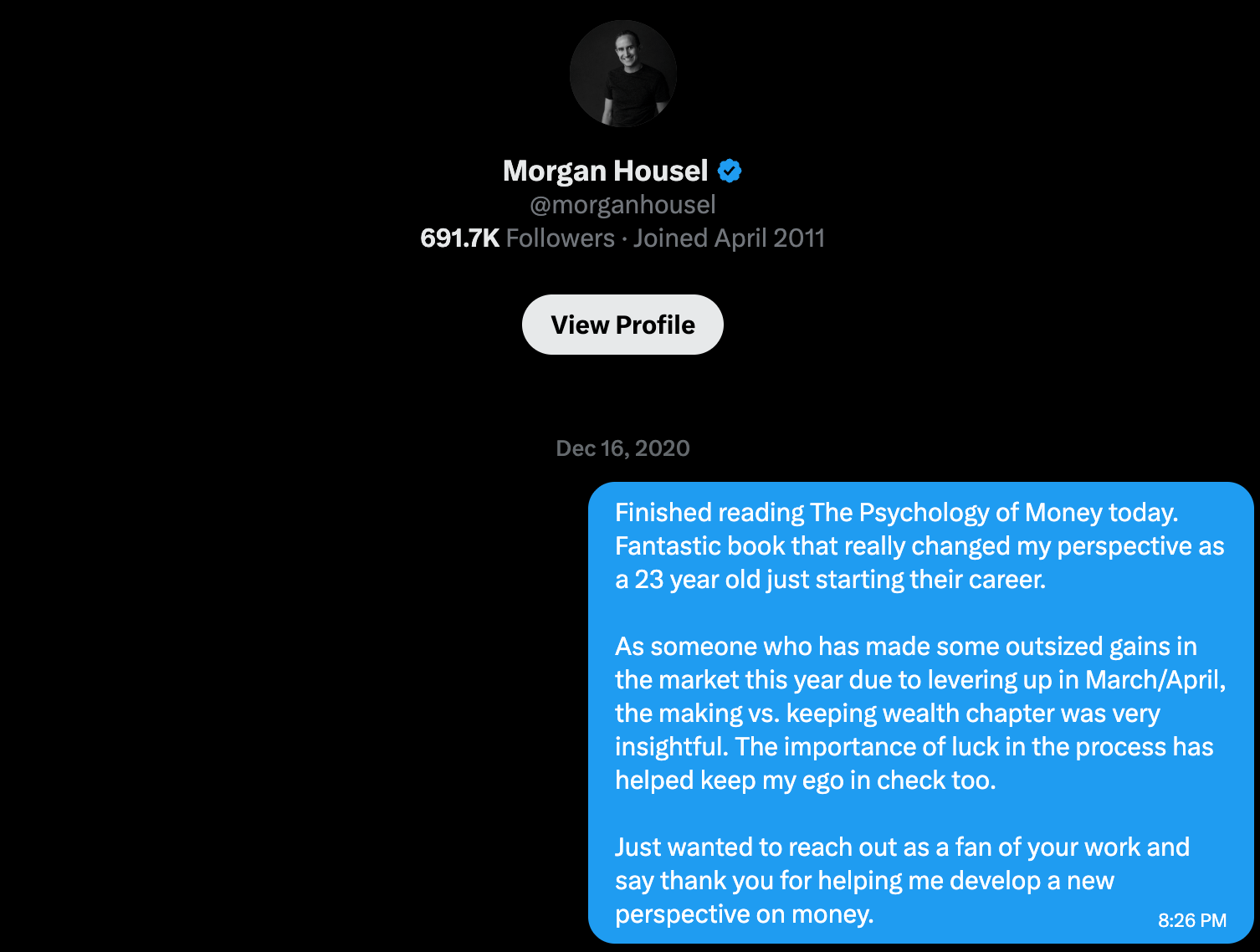
Morgan Housel, ~six years ago, after reading The Psychology of Money. This one was particularly cool, given that, six years later, he was one of the blurbs on the back of my book:
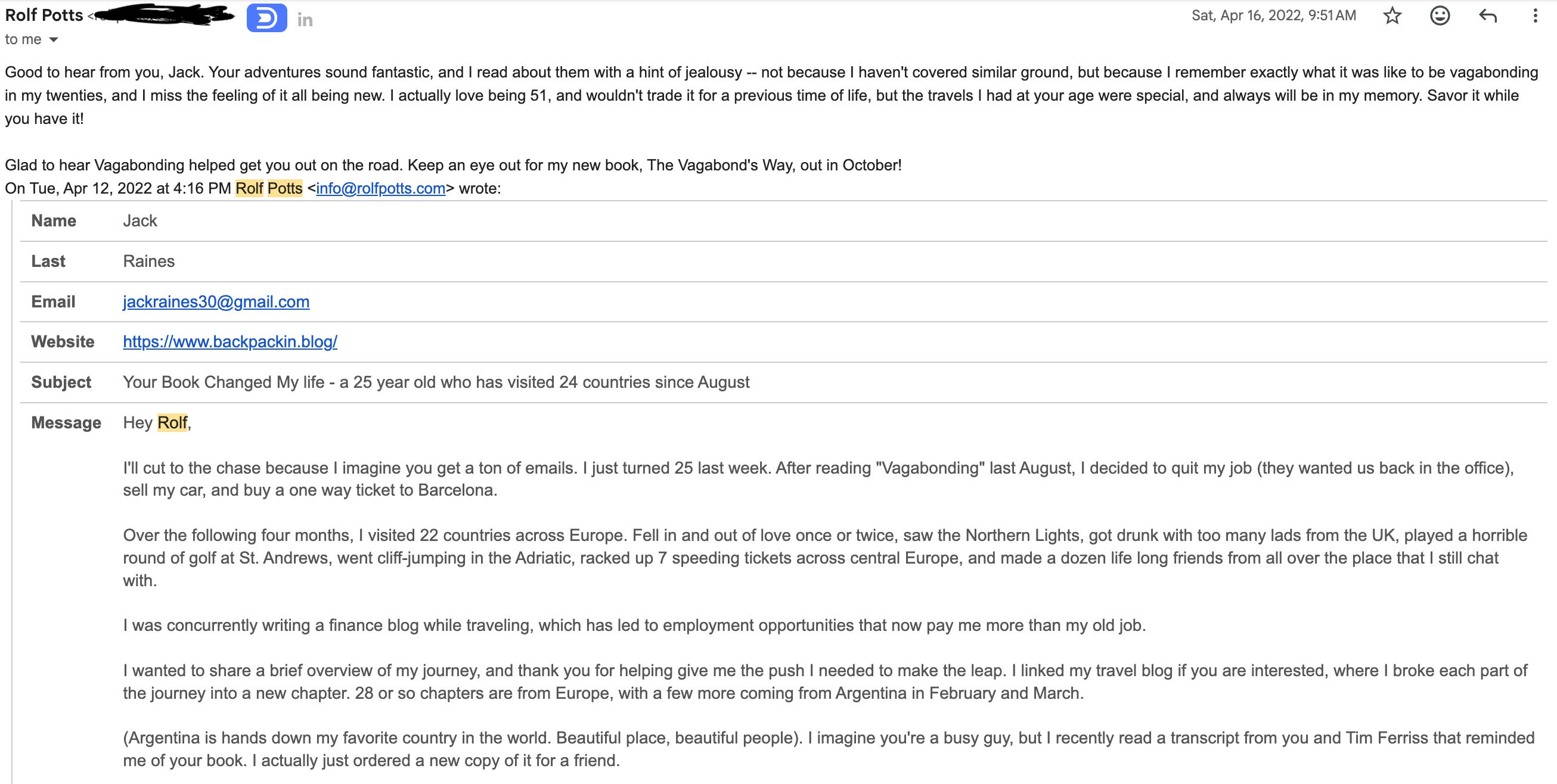
Rolf Potts, ~four years ago, whose book Vagabonding, was the impetus for me traveling abroad in 2021.
Given my own experience as a reader, my test for “how do I know my book is good,” is whether or not people I’ve never heard of will reach out to me after reading my book. The goal is write something that moves someone. The evidence that someone was moved was that they’ll tell you. Anyway, here’s some messages I’ve received in the last three days:
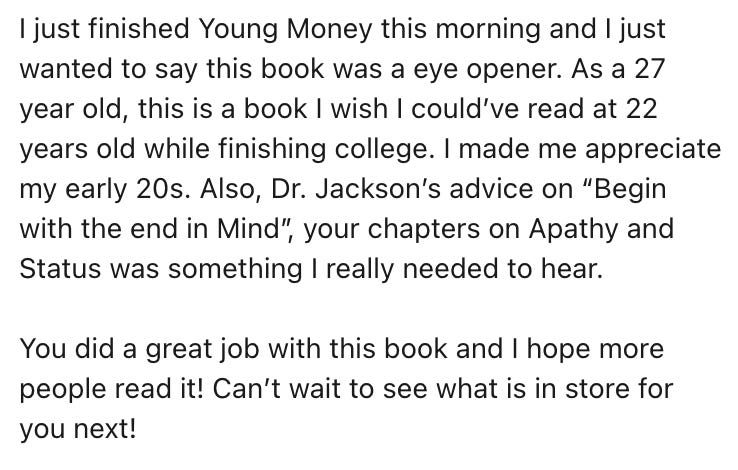
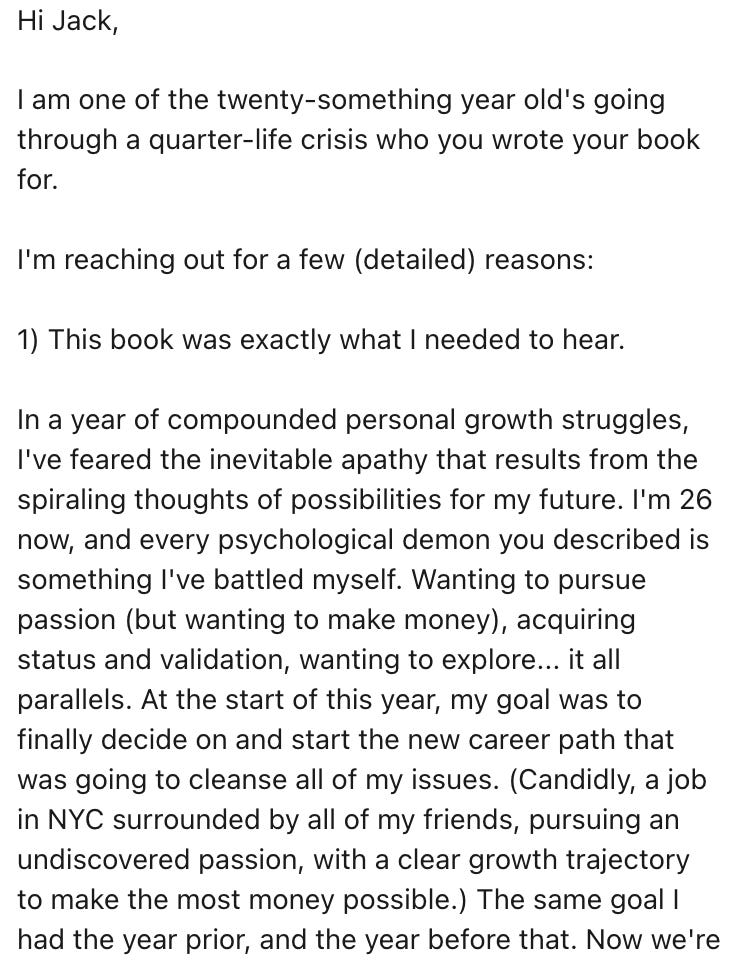
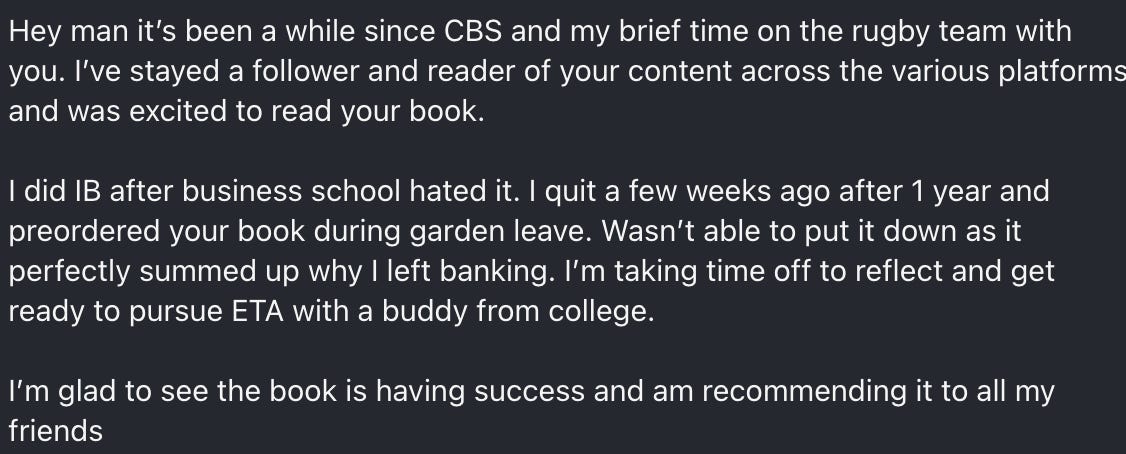
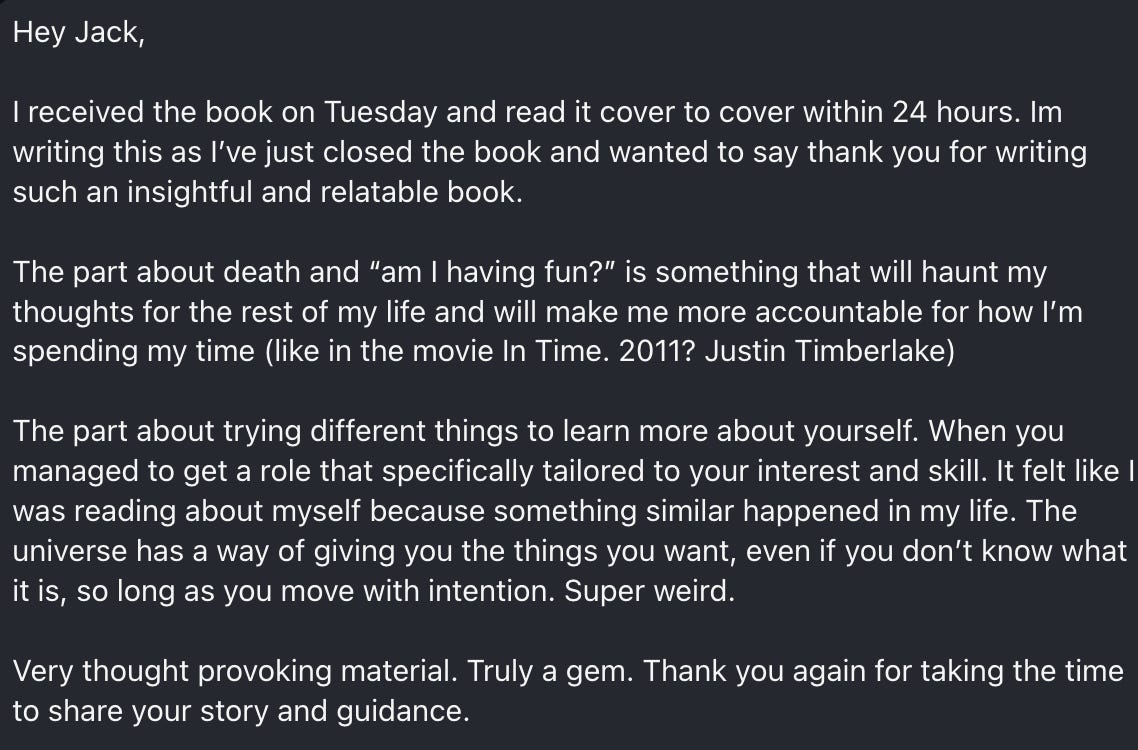
This is a small sample, but you get the idea. I’m happy to say I’m passing my own test; hopefully it keeps compounding. The takeaway here, if there is one, is that caring is cool. Taking risks is cool. Self-promotion, if your product is “good,” is self-respect. People deserve to hear about it.
Anyway, buy your copy of Young Money, and make sure to leave a review.
- Jack
And make sure you leave an Amazon review :)
This is such an awesome article. I love your willingness to reach out and connect with people, and I think you are right that being willing to do so means making a kind of peace with rejection.
Very excited to read the book as soon as I touch down in NYC! Crushing it