

Welcome to Young Money! If you’re new here, you can join the tens of thousands of subscribers receiving my essays each week by adding your email below.
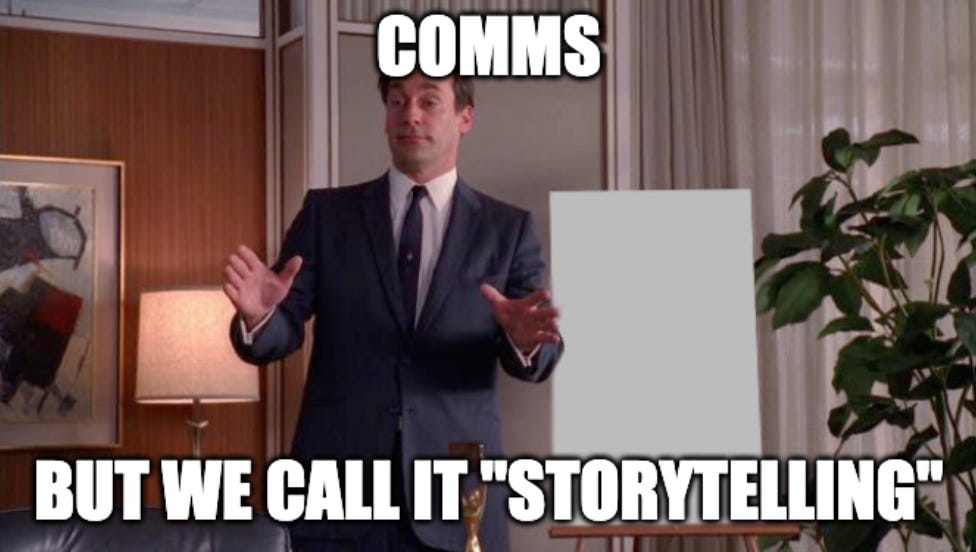
The Wall Street Journal published an interesting article last week on the tech world’s hottest new role: “chief storyteller.” The Journal noted that tech giants Microsoft and Google are recruiting storytelling leads for their cloud and security teams, while compliance software provider Vanta is paying up to $274,000 for a “head of storytelling.”
This is far from the first time company hiring practices involving wordcels have gone mega-viral. In 2023, for example, yogurt company Chobani offered $278,400 for a ghostwriter for their CEO (which, in hindsight, would have been a kickass gig during business school. But I digress).
Why is “storytelling” so hot? Perception is increasingly reality, and if you can control the narrative about your product / market, it makes it much easier to both hire and sell, which, in turn, makes your company better.
So everyone wants to “win the narrative.” Combine “storytelling” as tech’s hottest new buzz word with the fact that everyone is now looking for “taste,” and you have the perfect storm for tech companies shelling out $300,000+ to hire someone to make B2B SaaS seem cool.
The most interesting “narrative” plot to me, however, is how much narrative and “vibes” shape the AI arms race. Right now, there are four AI labs that matter: OpenAI, Google, Anthropic, and xAI. Everyone is either fighting for scraps at the model layer or building on top of / adjacent to the models themselves. Every time a new model drops, Twitter explodes with discourse over which model is best. “OpenAI is cooked; Gemini is GOATed” was the most recent narrative in AI, which, of course, will probably be outdated by the time you read this blog. Given that so much of AI sentiment is influenced in real-time online, it makes sense that the AI labs are willing to pay the most to “shape the narrative.”
If Dwarkesh Patel says the right/wrong thing about Nvidia on his podcast, its stock price could drop 10%. With new updates to models and chips and everything AI dropping weekly, it feels like everyone is waiting for someone to tell them “what’s best,” because it’s impossible to keep up with everything on your own. The companies know that, and they’re paying accordingly. For example, AI lab Anthropic is hiring a “Head of GTM Narrative” in San Francisco / New York, offering up to $400,000 salary (+ equity and other possible compensation), for responsibilities that include “Develop and own executive narratives,” “Drive cross-functional GTM alignment,” and “Lead narrative development without formal authority.”
My question, on all of this, is what do these companies expect a “Head of GTM Narrative” to do? It’s not like “sales,” where you’re selling, or “engineering,” where you’re building. “Crafting narrative” is a weird job. I do think, more than most, that narrative can, quite literally, lower your cost of capital and improve a business’s prospects. But I don’t think the right approach is hiring a CMO-esque person to “do narrative” to save your company. In my humble opinion, there are three ways to play the narrative game right:
The CEO crafts and controls the narrative through their public appearances and messaging.
An outside comms agency helps the CEO / executive team to shape their narrative.
Some sort of Chief of Staff / Product Marketing Lead / Customer-facing individual that can represent the business makes “narrative creation” part of their broader responsibilities.
Companies are extensions of their founders. Even massive, multi-hundred-billion dollar enterprises like OpenAI, Anthropic, and xAI are really just extensions of Altman, Dario, and Musk. Regardless of what a narrative lead says, the public perception of Anthropic is downstream of its perception of Dario. It is what it is. So if you really want to get “narrative” right, it starts with the boss.
You could bring in outside consultants to help with that narrative. And a lot of companies do this. It’s actually much easier to hire a professional narrative developer that does this full-time for different clients, and have them help you shape your brand/narrative, than it is to hire someone more junior to run it. It’s similar to why you would hire McKinsey instead of bringing on full-time consultants in-house: 1) establishing narrative / brand requires heavy upfront work, but after that, it’s a maintenance game with steady check ins. You hire someone to help you get narrative right, then they leave, but they don’t really need to be full time. 2) your team will listen to / respect a full-time “expert” that comes to fix your narrative moreso than an internal junior hire.
Now, I do think that you can have members of your team who aren’t necessarily called “narrative leads” who do, in fact, help you craft and control the narrative, if they show up where your customers are. For example, the person or people running “developer relations” for the big AI labs are, to me, heads of narrative. Expense solutions platform Ramp hired Ara Kharazian as their “chief economist,” but a big part of his role is drawing insights from Ramp’s spend data to tell stories about the economy and share those stories with the world. His job description isn’t “create the narrative,” but that is, effectively, what’s he’s doing.
Even with a mega-sized AI lab like Anthropic, the way to “win narrative” is have a product marketing lead that serves at the junction of sales/GTM and product teams, ensuring that those selling the product know how best to portray their offering to those buying it compared to whatever else is on the market. The more embedded narrative is in the building and selling, the better, because it’s hard to just slap “story” on top of something no one cares about and expect them to suddenly start caring.
Put differently, Stephen Spielberg isn’t suddenly going to make “reinforcement learning” cool, but a suave product marketer can position Claude Code so that your typical developer thinks, “Oh man, this is sick.”
People try to get fancy with “storytelling,” thinking you need insane launch videos, dozens of dramatic case studies, and all sorts of other sexy assets to win over customers. It’s really just a mixture of charisma and empathy. You just need someone who understands both the customer and the product that can generate a bit of FOMO in your users over what you’re building. And maybe there is a particular person with a particular role who can artfully connect the dots between customer and product and macro and micro to help paint the canvas, but they have to be integrated with the core business itself. Narrative has never mattered more than it does now, but plug and play solutions probably aren’t going to fix your brand.
- Jack
I appreciate reader feedback, so if you enjoyed today’s piece, let me know with a like or comment at the bottom of this page!
The rise of the “storyteller” role in startups feels deeply confused.
There's a paradox at the heart of this: the best storytellers do not want to write about B2B SaaS, nor do they want to crank out “5 things you need to know about AI’s impact on electronic health records.”
Great storytellers are temperamental, obsessive, nonlinear creatures. They work like lions—stalking, circling, disappearing for days—then striking. Founders want cows: mechanical, methodological, milked on schedule, and reared on process.
At the same time, most founders do not have the patience, stamina, or trust required to work with truly great storytellers. Storytelling requires ambiguity, dead ends, wasted drafts, tantrums, and an almost religious faith that something will emerge if you don’t interfere (See An Oral History of 'How the Grinch Stole Christmas’ from Vulture)
So we get the unstoppable force (companies desperate for narrative) meeting the immovable object (creatives who refuse to industrialize their soul).
The result? Much ado about nothing.
I’ve written about this dynamic before in a different costume:
“Silicon Valley has birthed another shiny acronym: the Forward Deployed Engineer, or FDE.
Sexy title, right? It sounds like digital soldiers parachuting into hostile corporate territories (behind customer lines!), armed with laptops and Stanley Tumblers. The reality is more familiar.
While the title is new and trendy, the job itself is an evolution of older roles: just with a sharper focus on rapid, customer-driven innovation and feedback
The FDE is, for all intents and purposes, the old solutions engineer/technical consultant in a fresh uniform. The tasks haven't changed: embed with clients, fix their broken systems, keep contracts alive through hand-holding. Same fundamental work, different wrapper. What changed was the story.
Give a role a new acronym, sprinkle in AI, and suddenly it feels scarce enough for every hiring manager's deck.
That's branding at work: turning the mundane into the magnificent through pure narrative perception.
In other words, rename the hammer and the whole market sees nails.”
“Head of Storytelling” risks becoming the same thing: a shiny title slapped onto fundamentally unsexy work, hoping narrative alone can alchemize the mundane into the magnificent.
Storytelling can’t save bad products, incoherent strategy, or founders unwilling to sit with discomfort. You can’t outsource meaning and expect magic.
If you want real storytellers, you have to tolerate lions.
If you want predictable output, don’t pretend you’re hiring poets.
If you want both at once, well, that’s how you end up with a title, a team, some ten-dollar words, and very little story at all.
More: https://www.whitenoise.email/p/sexy-titles-unsexy-work
Remind me of the “growth hacker” craze, and seems to be particularly common in developer tools world where “marketing” is a dirty word. It feels like a re-read of The Cluetrain Manifesto is in order for me over the holiday break…