

Welcome to Young Money! If you’re new here, you can join the tens of thousands of subscribers receiving my essays each week by adding your email below.
Brief Introduction:
Is the obvious thing “priced in”?
On February 28th, the United States and Israel launched a surprise attack against Iran, killing Supreme Leader Ali Khamenei and several other Iranian military officials. Iran retaliated by launching missile and drone strikes across the Middle East, targeting sites across Israel, as well as US military sites and other infrastructure sites, including data centers, across Bahrain, UAE, Kuwait, Qatar, Saudi Arabia, Oman, Jordan, and Iraq. Lebanon and Yemen have since attacked Israel in retaliation as well.
In the last month, thousands of people have been killed in the Middle East, with the majority of casualties coming from Iran, and Iran has effectively created a toll booth in the Strait of Hormuz, blocking transit for any US and Israeli vessels (as well as allied vessels). ~20 commercial ships have been hit in the last month, and shipping traffic has dropped from ~138 vessels per day to 2-6 (or at least 2-6 vessels using automatic identification systems).
20% of the world’s oil production goes through the Strait of Hormuz, and I don’t think it was a crazy extrapolation to think that, once the US and Israel decided to “Leroy Jenkins” the Supreme Leader of Iran and half of his cabinet, that Iran might retaliate with strikes against US assets in the Middle East and, in general, cause chaos in global energy markets. After all, if your country is going to shit, why not wreak havoc on the rest of the world on the way out? So, now, data centers and hotels are being quickscoped by rockets and drones, the Strait of Hormuz is an IRL game of battleship, and the speaker of Iran’s parliament is tweeting out macro-trading strategies for futures markets.
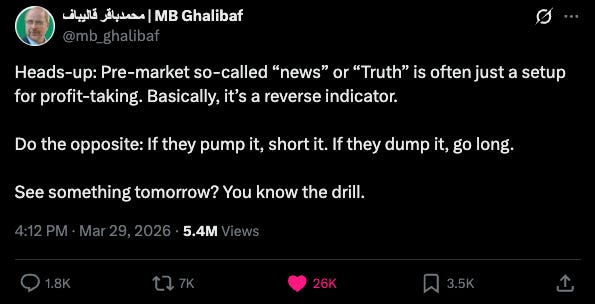
(An aside: X is still dominating “real-time conversations” for anything that matters, from geopolitical game theory to financial market mayhem. Congrats, Elon Musk).
If, on a Saturday, you assassinate the leadership of a country that controls the body of water through which 20% of the world’s oil moves, then you’d probably expect futures markets that Sunday to melt down in anticipation of global trade being thrown into a tailspin, or, at least the possibility of said tailspin.
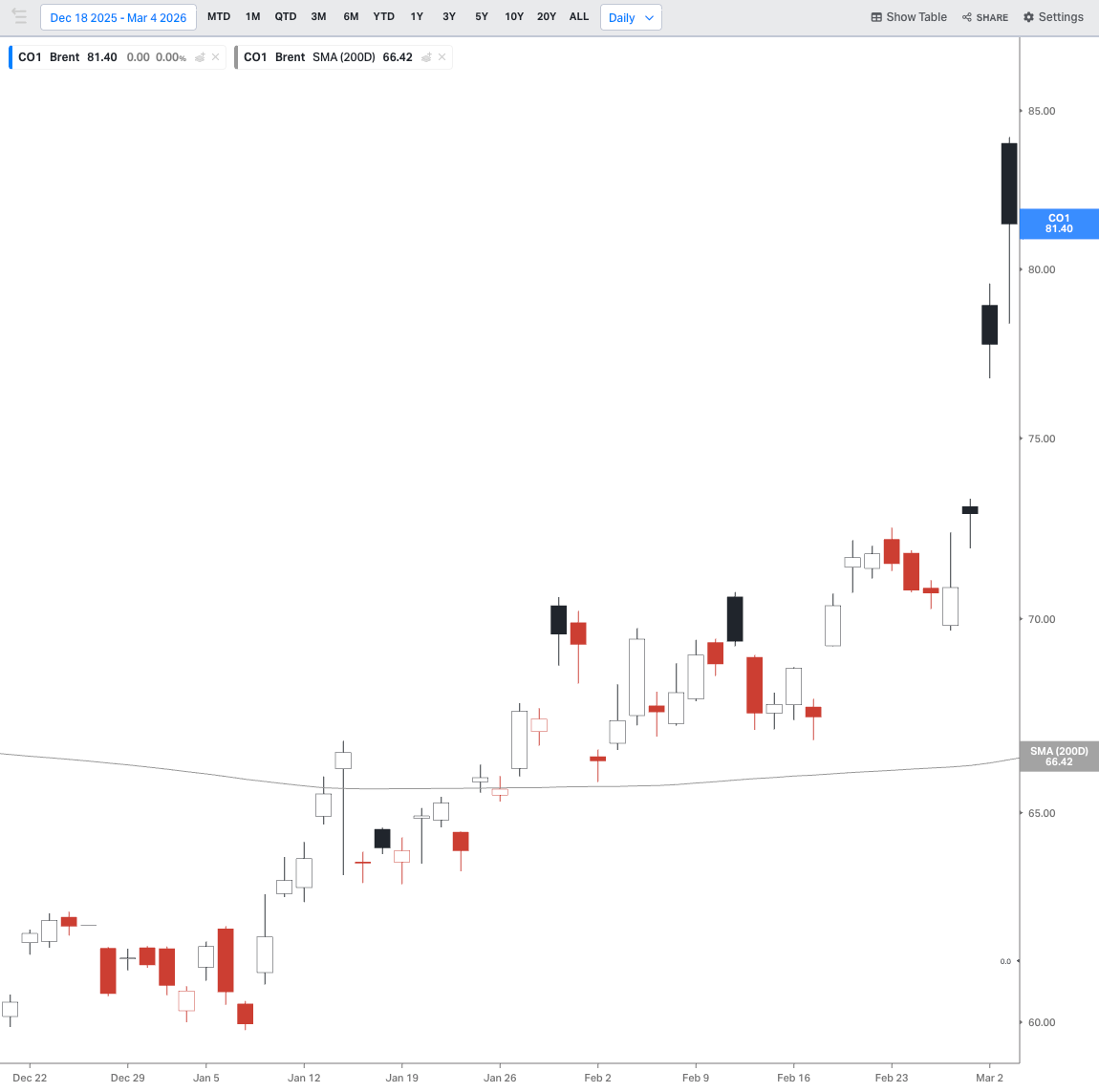
And oil futures did, initially, spike on March 1, with the price of Brent crude (global benchmark) jumping from ~$70 to ~$80 a barrel. But, still, markets weren’t pricing in Armageddon.
And the S&P 500 remained basically unchanged from the previous week.
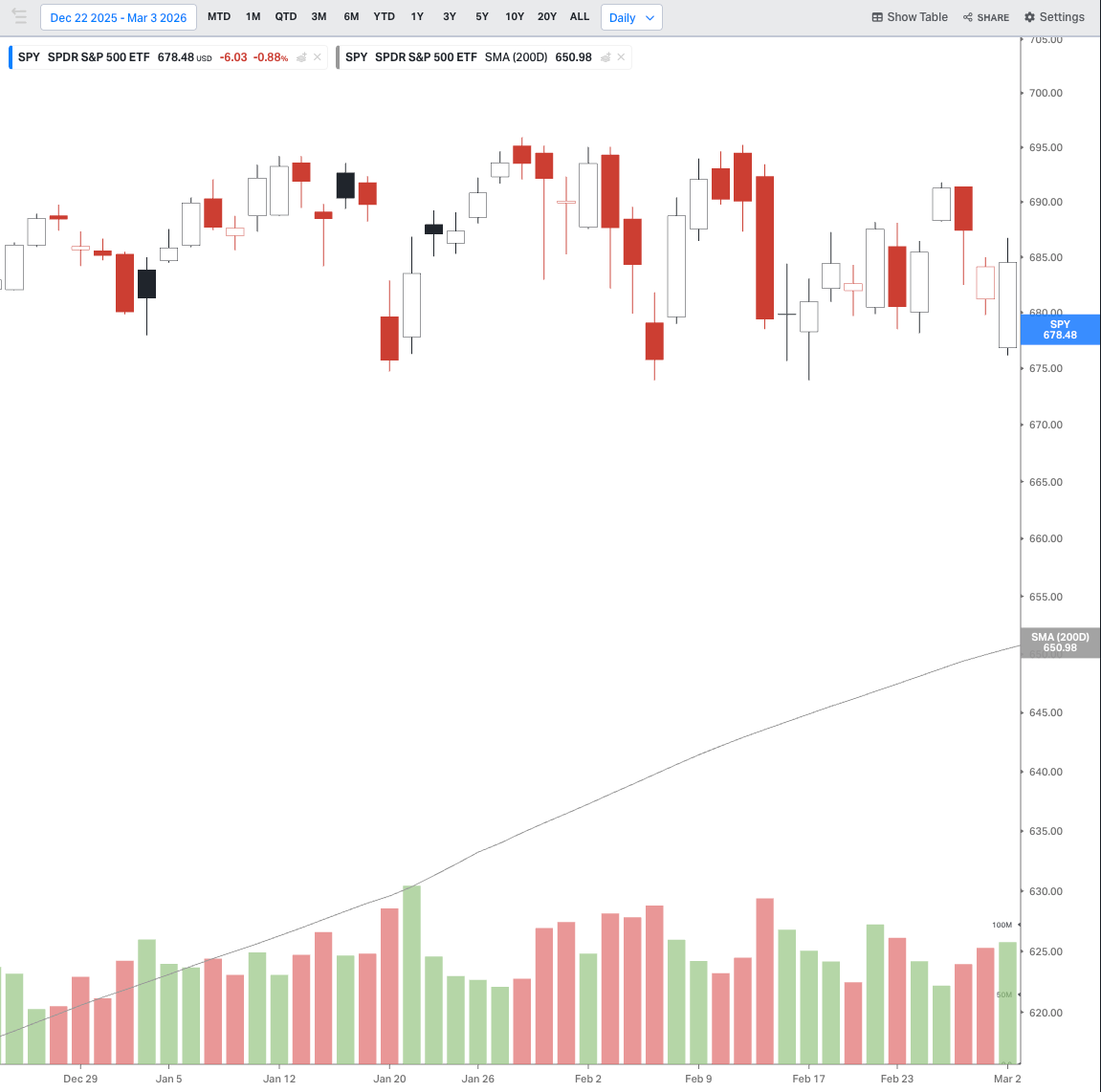
Some would say the war was “priced in.”
There’s a funny “priced in manifesto” that originated on r/Wallstreetbets six years ago that basically claimed that, yes, “everything is priced in.”
Don’t even ask the question. The answer is yes, it’s priced in. Think Amazon will beat the next earnings? That’s already been priced in. You work at the drive thru for Mickey D’s and found out that the burgers are made of human meat? Priced in. You think insiders don’t already know that? The market is an all powerful, all encompassing being that knows the very inner workings of your subconscious before you were even born. Your very existence was priced in decades ago when the market was valuing Standard Oil’s expected future earnings based on population growth that would lead to your birth, what age you would get a car, how many times you would drive your car every week, how many times you take the bus/train, etc. Anything you can think of has already been priced in, even the things you aren’t thinking of. You have no original thoughts. Your consciousness is just an illusion, a product of the omniscent market. Free will is a myth. The market sees all, knows all and will be there from the beginning of time until the end of the universe (the market has already priced in the heat death of the universe). So please, before you make a post on wsb asking whether AAPL has priced in earpods 11 sales or whatever, know that it has already been priced in and don’t ask such a dumb fucking question again.
The TLDR of this is there’s “no real alpha” in anything because the price of a particular stock or security perfectly reflects all available information about that stock or security, and markets are efficient, etc. I’ve never really thought that markets were all that efficient given that every single week we’re confronted with new evidence that markets are not, in fact, efficient.
A few somewhat recent examples:
SaaS stocks didn’t start selling off in earnest due to the threat of AI until mid-January of this year, two months after Opus 4.5, the first model that felt like it could truly “one-shot” tasks in Claude Code, came out in November 2025.
Fundrise Innovation Fund, LLC (ticker: VCX), a “public venture fund” with stakes in Anthropic, Databricks, OpenAI, Anduril, Ramp, SpaceX, and other hot startups, traded at ~30x above NAV a week after hitting the public markets.
Google being viewed as an “AI loser,” flat from Jan 2024 to April 2025, and then doubling once the market realized that, no, ChatGPT is not “winning” search, the Gemini models are fantastic, and Google is the only AI player who controls its own infrastructure stack.
Or how about the pandemic: Reports of Covid were coming out in December 2019, and it was a “known thing” globally by February 2020. The market continued to climb until mid-February of 2020.
Recent history shows that markets are, in fact, not efficient. I actually think they’re becoming less efficient. So anyway, back to Iran.
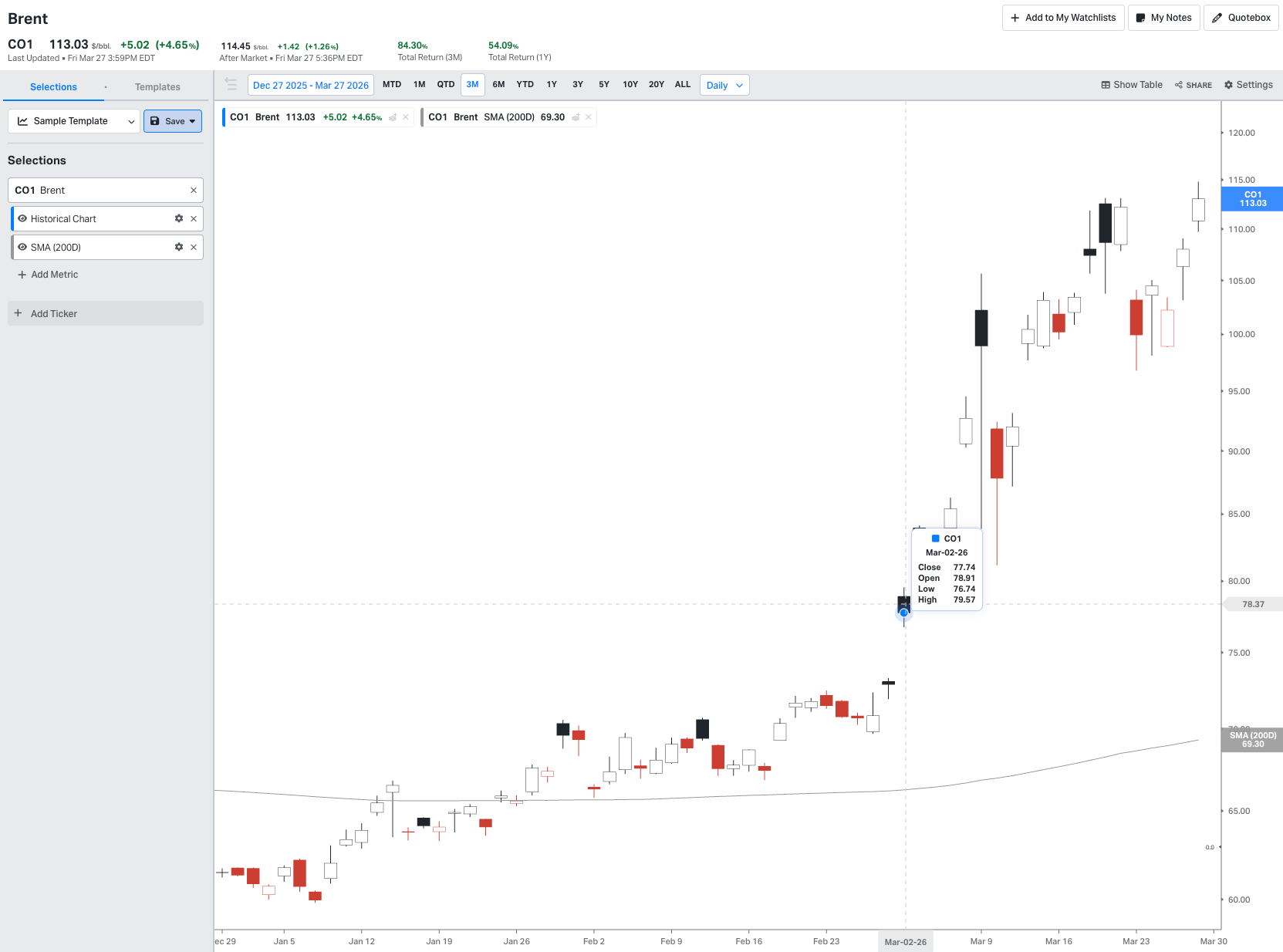
The US and Israel kill a lot of people in Iran and throw the country into chaos. Iran responds as one would expect: by breaking everything in the region. And then, finally, a week later, oil spiked above $100 a barrel. But it took another two weeks for the S&P to really start sliding on a catalyst that, presumably, emerged a couple of weeks earlier.
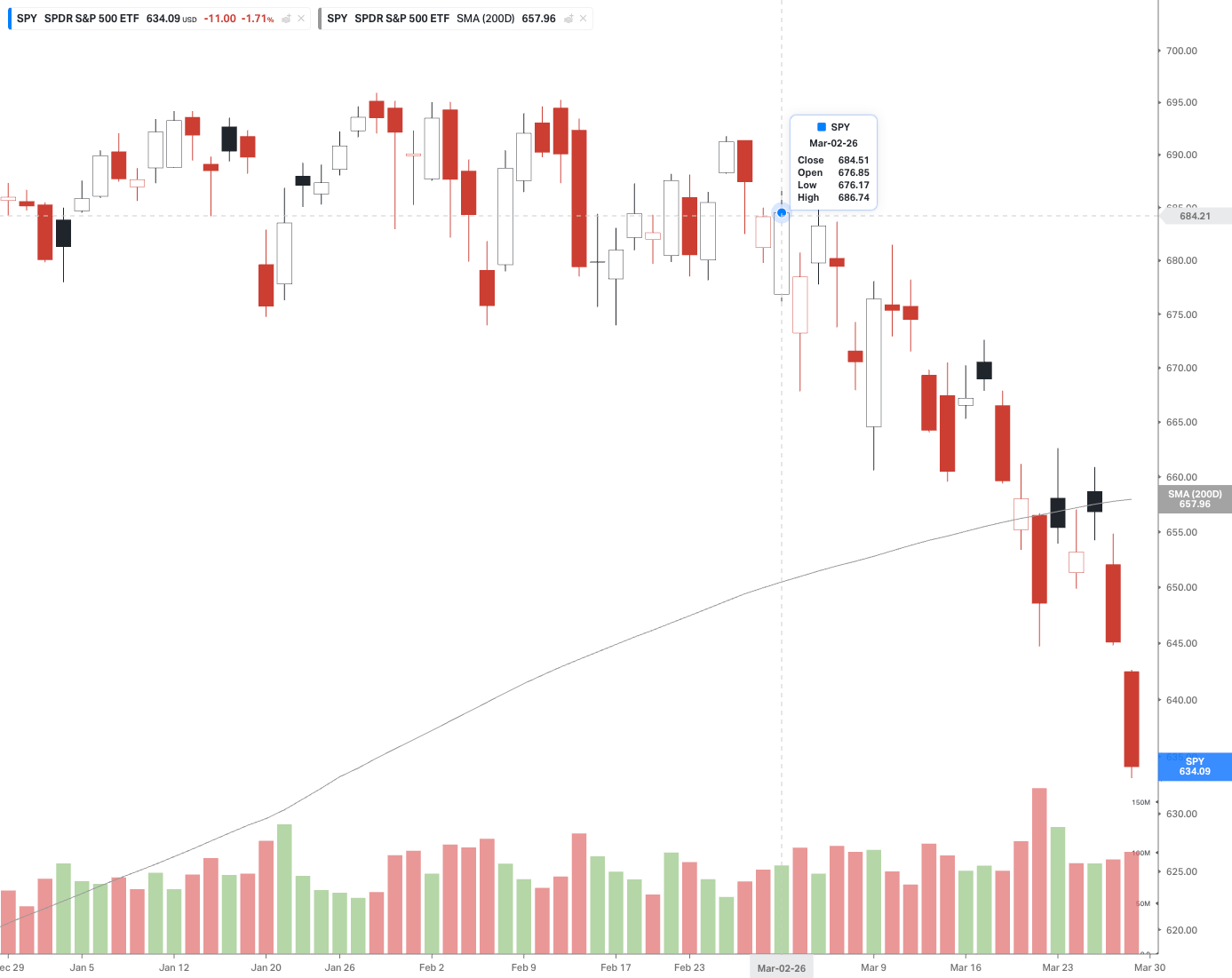
I think the markets have grown accustomed to the “TACO,” or “Trump Always Chickens Out” trade. When you threaten countries with tariffs as a negotiating tactic, it’s fairly straightforward to pull out once you get what you want (like if they pledge to buy more natural gas from you). When war breaks out, it takes two to TACO. And Iran has thus far (at least publicly) shut down any peace talks.
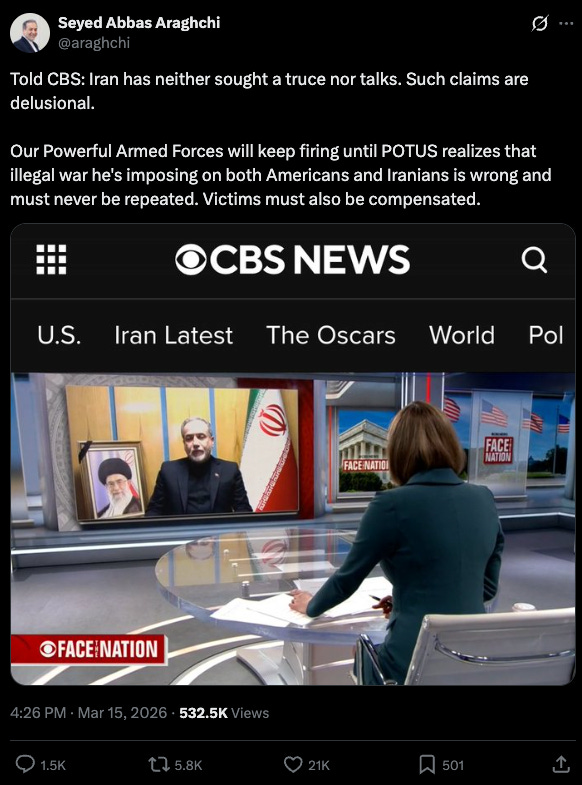
It just took the markets a couple of weeks to realize that, yes, this war will likely be prolonged, and this oil supply chain disruption could cause inflation, which could lead to rate hikes when we were instead pricing in “rate cuts,” which could… you get the idea.
I have no idea what will happen next. No one does. But sometimes the simple thesis is the right thesis. If you saw the news of the Iran strikes on February 28th, and then on March 2nd thought to yourself, “Hmmm, shouldn’t oil be higher given that… 20% of the world’s oil supply is cut off?" and then went long oil, you would have been up ~50% despite being a day “late” to the trade. Not particularly priced in, was it?
How much would you pay for Anthropic stock?
In 2012, brothers Ben and Dan Miller launched Fundrise, a crowdfunding platform for real estate investments, giving retail investors the opportunity to investment in real estate projects with as little as $100. A decade later, in an expansion beyond just real estate, they launched a “Fundrise Innovation Fund,” through which they planned to “democratize access to investments in “top private technology companies.” A year after the fund’s launch, they had invested $100m+ into companies including OpenAI, Anthropic, Databricks, Canva, ServiceTitan, and Vanta.
Last summer, Fundrise filed to list this fund publicly, which would basically create a publicly traded “fund” with positions in high-flying AI startups. It would also, importantly, create a permanent liquidity window for any investors who wanted to sell their stakes. For the three years that this fund was private, Fundrise capped quarterly liquidity tender offer requests at 5% of NAV (though the average request rate was sub-5%; in Q4 2025, only 1.5% of investors requested redemptions). With a public vehicle, fund investors could sell on the public markets to whoever they wanted whenever they wanted. And, unlike the quarterly redemptions, which were done at NAV, public markets could trade at premiums or discounts to NAV. The one catch with this listing: most investors would be bound to a 6-month lockup period.
At the time of the proxy filing, the fund had 28,346,610 shares eligible to vote for the conversion, and its NAV was ~$600 million, pricing the fund at ~$21 per share. Investors who invested before February 20, 2026 would have a six-month lockup. Investors who did not want to carry their positions into the six-month lockup could participate in one final tender offer at NAV on February 28th. This also meant that anyone who bought after February 20th but before the listing went through could have purchased shares at NAV (~$21 per share) and then sold at… whatever price the markets set the shares once they were listed.
So, the conversion gets approved, and now you have a situation where most of the shares (likely > 90%) are locked up in a fund that owns Anthropic, OpenAI, and SpaceX: the hottest private companies in the world. This trade went about as you’d expect: after opening at ~$31 per share (50% above NAV) with 90%+ of the float locked up, the stock proceeded to climb from $76 on the 19th, to $105 on the 20th. Then we had a weekend where, presumably, more retail investors discovered the fund, and by the following Wednesday, VCX was trading at ~$575, or ~30x NAV. Basically “valuing” Anthropic at ~$15 trillion.
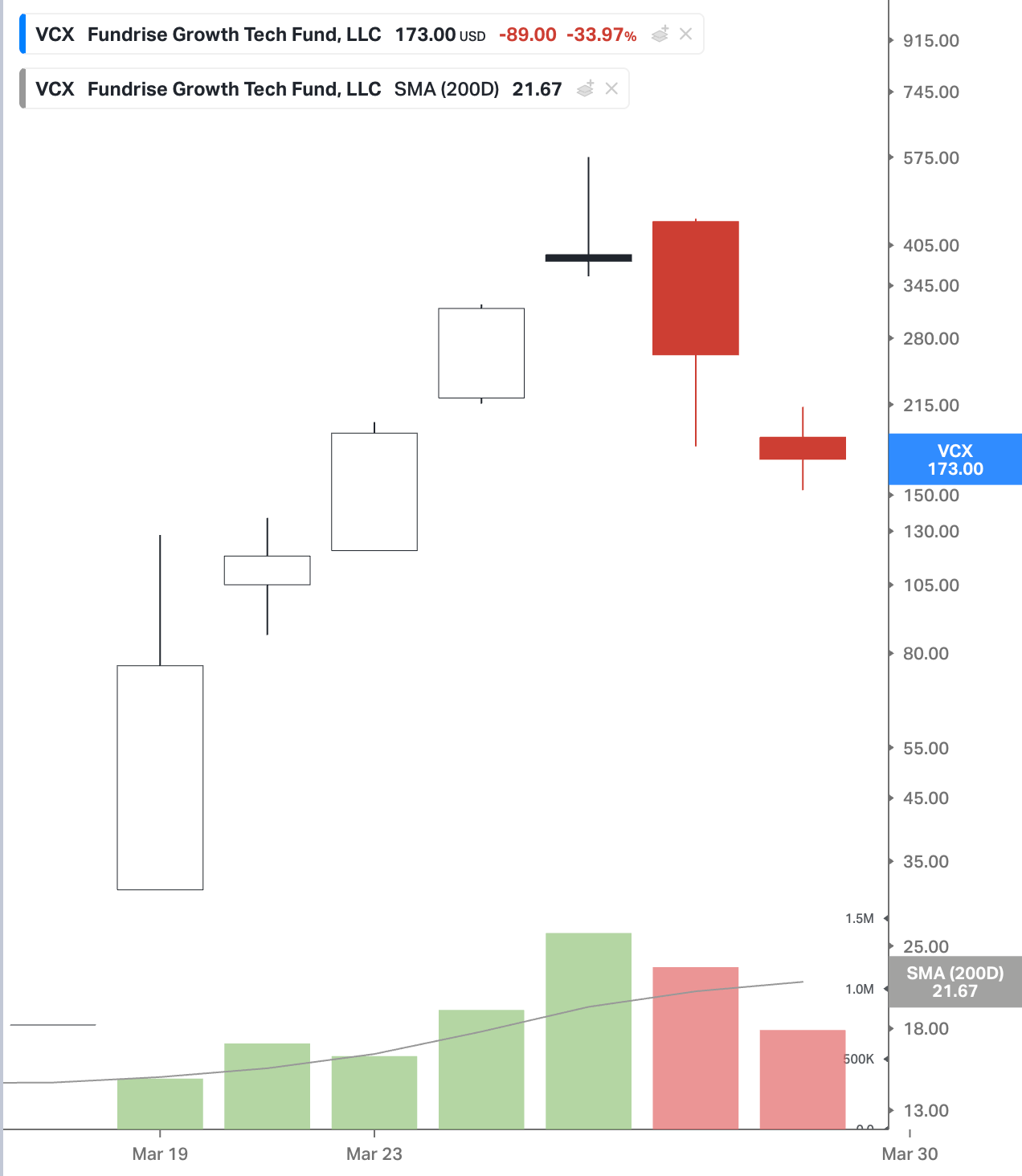
I remembered seeing this on the 20th and thinking, “Hmmm, that’s a crazy pop,” just to watch in disbelief as it 5x’d again from there the following week, but low float + meme stock is one hell of a combination. But the craziest thing is that you could have (and someone probably did!) buy private shares at NAV after the February 20th cutoff for the lockup, allowing them to flip their shares, risk-free, for a cool ~20x markup: ~$20 to $400 per share. To anyone who pulled this off: 1) kudos to you. To everyone else: how’s that for an “efficient market hypothesis”?
Perplexity Computer is Surprisingly Great
I’ve tried my best to stay on top of “the current thing” with AI tools over the last year or so (should I publish a longer piece on everything I’m using in AI now?), but one tool I initially loved, then hated, but now love again is Perplexity Computer. For context: Perplexity was one of the hotter AI tools deemed to be a possible “Google killer” a few years ago. They were the first mainstream “AI search” tool built on top of other models from AI labs like OpenAI and Anthropic, and their product was neat in 2023 and early 2024. But as the AI labs rolled out their own internal “deep research” products, it looked like Perplexity was going to quickly get commoditized.
Combine that with Perplexity’s increasingly-ridiculous “M&A proposals,” like attempting to “buy” Chrome…
Artificial intelligence startup Perplexity AI has made an unsolicited $34.5 billion bid for Google’s Chrome browser, CNBC confirmed on Tuesday.
That figure is higher than Perplexity’s current valuation, but the company said several investors have agreed to back the deal. In July, Perplexity was valued at $18 billion as part of an extension that valued the company at $14 billion months earlier.
and TikTok…
Perplexity AI officially made a play for TikTok on Saturday, submitting a bid to its parent company, ByteDance, to create a new merged entity combining Perplexity, TikTok U.S. and new capital partners, CNBC has learned.
The new structure would allow for most of ByteDance’s existing investors to retain their equity stakes and would bring more video to Perplexity, according to a source familiar with the situation, who asked to remain anonymous due to the confidential nature of the potential deal.
Despite having nowhere-near enough capital to afford either of those purchases, and I wrote the company off as a joke. And then they launched Perplexity Computer. And it… rocks.
I’m a big Claude Code guy. I need to build stuff with code, it just does it. And it’s gotten better and better. It can work with local files, Github files, whatever. Last week, I was trying to revamp a separate personal website, in which I wanted to add a chronological list of links to everything I’ve written online to share in one page. Claude could not, for the life of it, check the URLs for all of my Substack posts, validate their title names and dates, and update the Github repo where I’m hosting that website. Perplexity Computer, on one prompt, managed to work around Substack and Cloudflare’s bot blocker, deduce all of the correct titles and publishing dates, and add them, with working hyperlinks, to my website, in ~20 minutes with no errors. For whatever reason, I find it much more capable than Claude when working directly with Github repos, + it can “build” anything you’d build with Claude Code or Codex in a digital server and let you download the code.
While some functionalities are still needed, like local file access, it’s really, really good for cranking out work in Github repos. No idea if they’ll justify their valuation, but the computer tool is just wonderful.
Content, Recs, Other Notes:
Fun April 2025 blog from Andrej Karpathy on his experience vibe-coding a menu visualization tool for fancy restaurants.
Logan Bartlett and the Redpoint team put together a great deck on the state of SaaS + AI startups. Very good read for those interested.
TBPN hosted a live debate between “pharma bro” Martin Shkreli and Superpower founder and peptide maximalist Max Marchione. I think Shkreli is a wizard and generally fantastic Twitter follow and love watching him cook folks in debate format.
We’re hosting Slow Ventures Etiquette School 2.0 in NYC tomorrow night; if you’re a founder and want to learn about cologne, caviar, and not falling in love with your AI chatbot, come hang.
We’re also hosting an AI bootcamp for creators in San Francisco next week. If you’re a writer/Youtuber/podcaster/whatever that wants to up your AI game, pull up.
- Jack
I appreciate reader feedback, so if you enjoyed today’s piece, let me know with a like or comment at the bottom of this page!
I wonder how many people realize Zoom (yes the videoconferencing company) owns a bunch of Anthropic also.
I would argue the rise of indexing along with 0 cost investing/trading in real time has made markets hyper inefficient in the short term - extremely efficient in the long term.