

Welcome to Young Money! If you’re new here, you can join the tens of thousands of subscribers receiving my essays each week by adding your email below.
Happy Tuesday to those who celebrate. Getting back in the habit of making this a weekly column of sorts again, digging into the more interesting stories I see in tech/markets/culture over the preceding week. In today’s letter:
X investors are set to get paid thanks to Elon’s latest financial engineering.
Fake quantum companies have valuable stock.
Murray Hill Guy broke dating app Twitter.
Other assorted links.
Elon Musk = Financial Engineering King
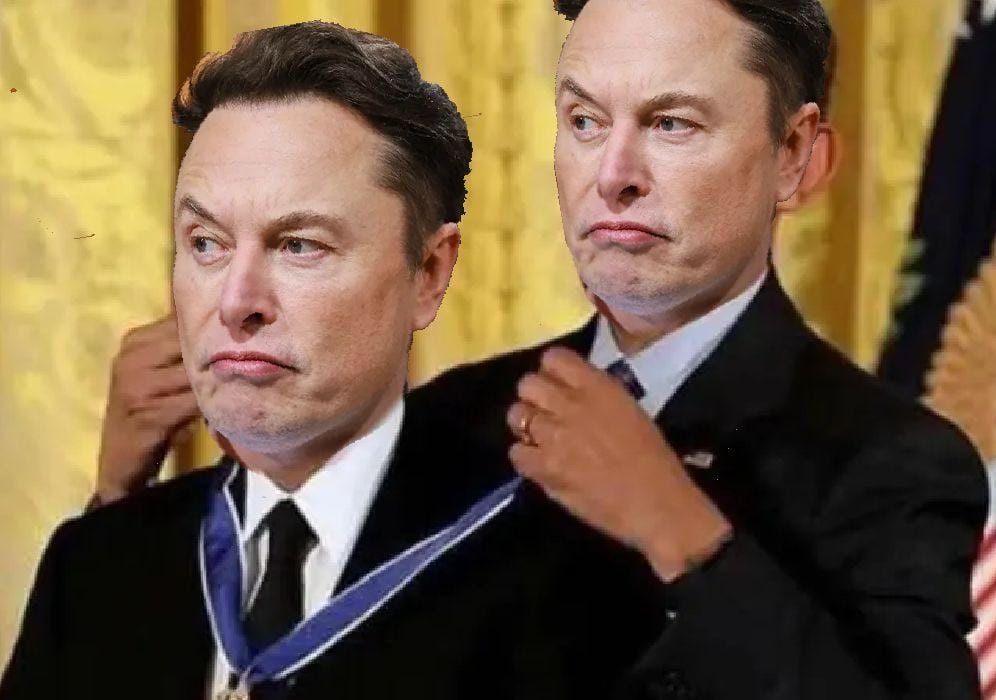
Grab a stick of chalk and write this over, and over, and over again on a blackboard:
“Never bet against Elon Musk. Never bet against Elon Musk. Never bet against Elon Musk.”
Last night, The Information reported that Elon Musk’s SpaceX is acquiring Elon Musk’s xAI (which had previously acquired Elon Musk’s X), for $250 billion in a deal that would value the combined entity at $1.25 trillion dollars. The result: Musk’s rockets, satellites, social media platform, and AI lab are now all one business (and, importantly, investors in any of those entities now own shares in SpaceX) as the launch company is gearing up for an IPO in what will likely be a meme stock of epic proportions.
SpaceX investors and employees are getting paid, xAI investors and employees are getting paid, and the seven X engineers who weren’t fired when Musk cut 80% of the company’s headcount are, somehow, now going to receive rocketship IPO dollars for their previously overpriced, underwater equity in a dying social media company.
God bless Elon Musk’s financial engineering.
This deal (and the deals preceding it) was, of course, possible because Musk is the majority/controlling shareholder of SpaceX (where he owns 42% of the company), xAI, and X. The farfetched theory of “how this all works” is that we’re going to need a lot more compute as AI demand continues to explode, AI data centers in space will become a thing, combining xAI with SpaceX puts all of that infrastructure in one house, and xAI’s models should have a data advantage thanks to the constant stream of real-time training data from user-generated content on X. The more cynical but (in my humble opinion) more likely theory is that this is a “thank you” from Musk to the investors who were willing to back his overpriced purchase of a dumpster fire social media network.
There is a narrative, now, that Elon Musk “saved democracy” buy purchasing Twitter for $44 billion. There might be some layer of truth to this narrative, but Musk also tried as hard as possible to get out of buying Twitter. In April 2022, when Twitter was publicly traded, he signed a definitive agreement to buy it for $44 billion, or $54,20 per share. This was a stupid price to pay for a terrible business, especially when the tech market collapsed over the next six months.
For context on how bad the tech market was in 2022, the market cap of Meta, which is currently worth ~$2 trillion, collapsed from $1 trillion in December 2021 to below $250 billion in October 2022 (xAI, which didn’t even exist in Q4 2022, is now worth $250 billion), and Nvidia, which is now worth $4.5 trillion, fell from $800 billion to $300 billion. Twitter, by any conceivable metric, was “worth” maybe ~$15 billion at the time.
But Musk had top-ticked a bid in April that he was legally bound to. In May and June of 2022, he tried to bail on the acquisition, claiming Twitter hadn’t properly disclosed the percentage of “bot” accounts, before ultimately terminating the acquisition agreement in July due to a “material breach” for failing to provide adequate information on spam bots (in total, Musk tried to bail on the deal 3x).
Twitter sued Musk for bailing, the courts were leaning toward ruling in favor of Twitter, the social media platform rejected Musk’s reduced offers to buy it for $31b and $40b, and Musk ultimately reversed course and went through with his initial $44 billion offer. It’s not terribly uncommon for shareholders to sue to avoid an acquisition, but it is very, very rare for a company to sue to be acquired. But everyone, especially Musk, knew the business of Twitter was a dumpster fire not worth $44 billion. If the goal of a CEO is to create shareholder value for their business, Parag Agrawal certainly did his job when Musk paid 3x more than it was “worth.”
Musk contributed $27 billion in cash (primarily raised through selling Tesla stock), outside investors (Larry Ellison, Sequoia, a16z, Fidelity, Saudi Prince Alwaleed bin Talal, and others) invested $7.1 billion, and banks committed $13 billion in debt financing, which no one else wanted, so it was stuck on their books for a couple of years. By September 2024, Fidelity had slashed its internal valuation of its X stake by 72%, marking it down from $54.20 per share to $15, or a ~12 billion valuation, and its debt was trading well below par value.
23 months after the Twitter purchase, it was a bad investment.
However, Musk rewarded the folks who backed his Twitter purchase by giving them preferential access to invest in xAI in 2023, before outright “buying” X with xAI in March 2025 for around the same price he initially bought Twitter for in 2022 ($45 billion enterprise value, $33 billion equity), making investors whole + giving them even more access to xAI. Basically, anyone who invested in Twitter in 2022 got their money back for their X investments in the form of xAI stock at a ~$113 billion combined valuation, along with access to make earlier investments in xAI. With the SpaceX / xAI deal valuing the AI platform at $250 billion, those investors’ stakes more than doubled in just ~10 months.
TLDR: if you invested in Twitter, the real-time news media platform that never figured out how to make money, you now own shares in a trillion-dollar rocket ship company preparing for its IPO.
If your deal memo for investing in Twitter at a $44 billion valuation included “return to growth,” “better operational discipline,” or “stronger margins due to more efficient ad targeting,” you would have been sorely disappointed as advertisers fled the platform and X’s revenue collapsed. But if your deal memo for investing in Twitter at a $44 billion valuation said “Who cares, it’s Elon?” You were right, and you’ll triple your money when SpaceX IPOs this year. A big congrats to Morgan Stanley, who’s been making billions in deal fees on these restructurings and acquisitions.
I’m so curious if anyone managed to buy a secondary stake in X when Fidelity was marking down their valuation? If so, have fun being rich.
Fake Quantum Company Buys Real Actual Company
From April 2020 to ~August 2021, I spent every waking moment trading “SPAC warrants.” I tell this story a lot, so I’m not going to fully re-hash it, but the TLDR is that when I was 23, I was pretty good at trading this weird market bubble, to the tune of ~6,000% returns in less than a year. Then too many people raised SPACs, there wasn’t enough money to go around, I started trading microcap stocks instead, and I lost 3x my salary at the time in like ~7 minutes on a bad earnings print. So I stopped trading stocks after that. You can read that full story here, if you’re interested. It’s pretty funny.
Anyway, the reason I bring this up is that, while most of these former SPACs have since gone bankrupt or been acquired by private equity firms for pennies on the dollar, some are still kicking in the public markets! For example, DraftKings is trading ~3x from when it announced a deal to go public in late 2019. Not bad.
Generally, a few “real” companies have survived or thrived since 2020/2021, but all of the pure hype companies, like Nikola Motors and a slew of failed EV “manufacturers,” have gone bust.
And then there’s IONQ.
IONQ is an American quantum computer hardware and software company founded by a couple of Duke professors back in 2015. The TLDR is that the two academics wrote a research paper called Scaling the Ion Trap Quantum Processor, venture capital fund New Enterprise Associates gave them $2 million to commercialize the technology proposed in their paper, and two years later they raised another $20 million (from Google + New Enterprise Associates). They then hired an Amazon exec to expand their commercialization efforts, they signed partnerships with Amazon Web Services, Microsoft Azure, and Google Cloud to make quantum computers available to the public.
I am not going to waste your time by explaining the intricacies of quantum computing other than to say that quantum computing is (theoretically) good at doing a small subset of tasks incredibly quickly under extremely precise environmental conditions that may or may not have any mainstream economic viability at any point in the future (for more on this, see Martin Shkreli’s essay on why quantum is stupid, or why several specific quantum stocks, including IONQ, are overvalued).
In 2020, IONQ had no revenue, it was burning ~$16 million a year, it had ~$36 million cash on its balance sheet, and it was forecasting net losses until 2025. IONQ was going to need more money in the next year.
And then the SPAC boom took off.
IONQ was a fantastic SPAC merger target in 2020 because investors were throwing money at any and every buzz word, particularly “electric vehicle,” “solar,” “space,” “gambling,” “lidar,” and “quantum.” So IONQ signed a deal to go public through a SPAC called dMY III that would value the business at ~$2b ($1.4b excluding cash). The original investor deck, which is still available here, projected $60m in 2024 revenue and $237m in 2025 revenue.
Five years later, IONQ has sharply missed those projections: it only generated $68m in revenue through the first nine months of 2025. A normal business, under similar circumstances, would likely have collapsed from its $10 per share, $2 billion market cap.
IONQ is trading at $39 a share at a $13.6 billion market capitalization. Why? Because “quantum.”
See, you can be totally “right” about your negative outlook on the present value of a company based on its lackluster commercial opportunities, but if the median buyer of that stock doesn’t actually understand how quantum works, and that median buyer comes in volume, then it doesn’t matter if the business is stupid. They like the stock because it’s “quantum,” and they buy it because “quantum,” even though they don’t know what “quantum” is. En masse, the stock will go up.
Example: Shkreli asks stock market influencer Shay Boloor, “Tell me what algorithm can you run on these quantum computers that is useful?” Influencer proceeds to… ramble.
But it doesn’t matter. With the right investor base, bad company becomes good stock and IONQ is now worth ~$14 billion despite not really doing anything.
What gets interesting is that when your stock price pumps really high, it becomes an asset that can be used smaller companies that are real. So, last week, fake company IONQ bought real company SkyWater Technology for ~$1.8 billion.
SkyWater Technology is a US-based semiconductor foundry (think TSMC or Intel) that has carved out a niche manufacturing semiconductors for quantum computing companies. It did $150 million in revenue last quarter and $350 million in revenue over the last year (it’s a real company).
If you are IONQ, and retail invested have pumped your business to a $14 billion valuation, and suddenly, you’re worth 7x more than a potential supplier despite making ~25% of its revenue, the optimal move is to issue more of your overvalued stock to buy “real” businesses that impact your cost structure. The irony here is that, by doing that, IONQ does make itself more valuable, despite initially being ridiculously overvalued, because it now owns a real foundry making real chips. So I guess the optimal capital allocation strategy, if you’re the CEO of a company that’s trading like a meme stock, is take full advantage of your cheap equity to buy real businesses before the market realizes you’re fake. If you’re lucky, those acquisitions could prove to make you the real company the market is already pricing you as.
Murray Hill Guy Broke Twitter
There is this account on Twitter (X) called “Murray Hill Guy.” There’s a dozen or so “guys” named after different neighborhoods on Twitter. East Village Guy. Mid Thirties Manhattan Guy. There was a West Village Guy, but he moved to DC and changed his handle. I personally love the network of folks using anonymous Twitter accounts to hide from their employers while they shitpost online.
Any way, for those of you not in New York, Murray Hill is the stereotypical “22-24-year-old fresh out of school” neighborhood, and the guy running the “Murray Hill Guy” Twitter account has become one of the main characters on the internet for providing nonstop dating discourse commentary. He’s been doxxed a few times now after different girls caught him sharing Hinge screenshots on Twitter, and apparently he’s a 5’9 ~30-ish-year-old dude who hits the gym a lot. I used to hate him. Now I love him. His content is hysterical. Highly recommend a follow.
Anyway, he made a new Hinge using a girl friend’s pictures to see what the female experience on dating apps is like, and documented the whole thing on Twitter for the world to see. The girl whose pictures he used is, objectively, pretty, but not like Margot Robbie super model level.
He (She?) hit something like 1,000 likes in a less than a day. There was some good humor here, like him sending a dozen guys to The Spaniard on Thursday, but it was unironically a pretty good social experiment of just how poor the structure of dating apps actually is, especially for dudes. The odds of your like even being seen, let alone responded to, are next to none simply due to the volume game you’re competing in. If it’s a peak traffic time, you’ll be buried so far down the backlog it’s practically hopeless.
Considering that fertility rates are declining and girls complain that guys “won’t approach them” any more, might I suggest ditching the apps and instead hitting… a bar? Gym class? Maybe church? (I went for the first time in I don’t know how long last weekend).
What I’m Reading / Consuming
Interesting article by Amelia Miller in the Free Press considering what the world would be like if men and women had matching fertility windows; AKA: what if men had to get vasectomies around the age that women typically begin struggling with fertility concerns. In the insurance and pension industries, the risk of mismatched duration between assets and liabilities is real. For example: if you buy a bunch of long-dated bonds, then rates spike and your bonds drop in value at the same time that a cash outflow is due, and you don’t have enough liquid/short-term assets to cover the cost, you’ll have to sell your other bonds at a loss to make the payment. The issue was duration mismatch: the assets were longer-dated than the pension liabilities. Male/female fertility windows aren’t all that different: men’s windows are longer-dated than women’s, creating a mismatch in the market where one party has to “commit” earlier than the other, biologically speaking. No, I don’t think we should mandate vasectomies, but as a 28-year-old dude who hasn’t thought all that much about “fertility” for myself, it’s an interesting thought experiment.
In case you missed it over the weekend, an “AI-agent-first social app,” Moltbook, went live. A few weeks ago, a software called OpenClaw that gives AI agents full access to everything on their users’ computers went viral, and thousands of folks ordered new Mac Minis to test out their AI system agent. Then someone made a Reddit-like forum, Moltbook, for the agents to hang out in. Naturally, screenshots went viral all over Twitter of AI agents “plotting” to overthrow humans (all of the mass-hysteria screenshots were almost-certainly just humans prompting their AI bots to act in a certain way), but now it seems like people are already moving on. However, while “Moltbook” might not be a permanent thing, this phenomenon of AI agents having full access to all of your memories (through your texts, photos, emails, etc), and being able to interact with other AI agents is… weird. Very likely we see some versions of new consumer apps (think about how dialed a dating app would be if it had access to all of your data?) as all of the information we have becomes additional context.
- Jack
I appreciate reader feedback, so if you enjoyed today’s piece, let me know with a like or comment at the bottom of this page!
fantastic recap of the musk drama around Twitter.
Nothing says 'saving democracy' like a forced buyout of the public followed by a billion-dollar bailout for the 1%