

Welcome to Young Money! If you’re new here, you can join the tens of thousands of subscribers receiving my essays each week by adding your email here. And if you like my blog, you should pre-order my first book, Young Money, by clicking below:
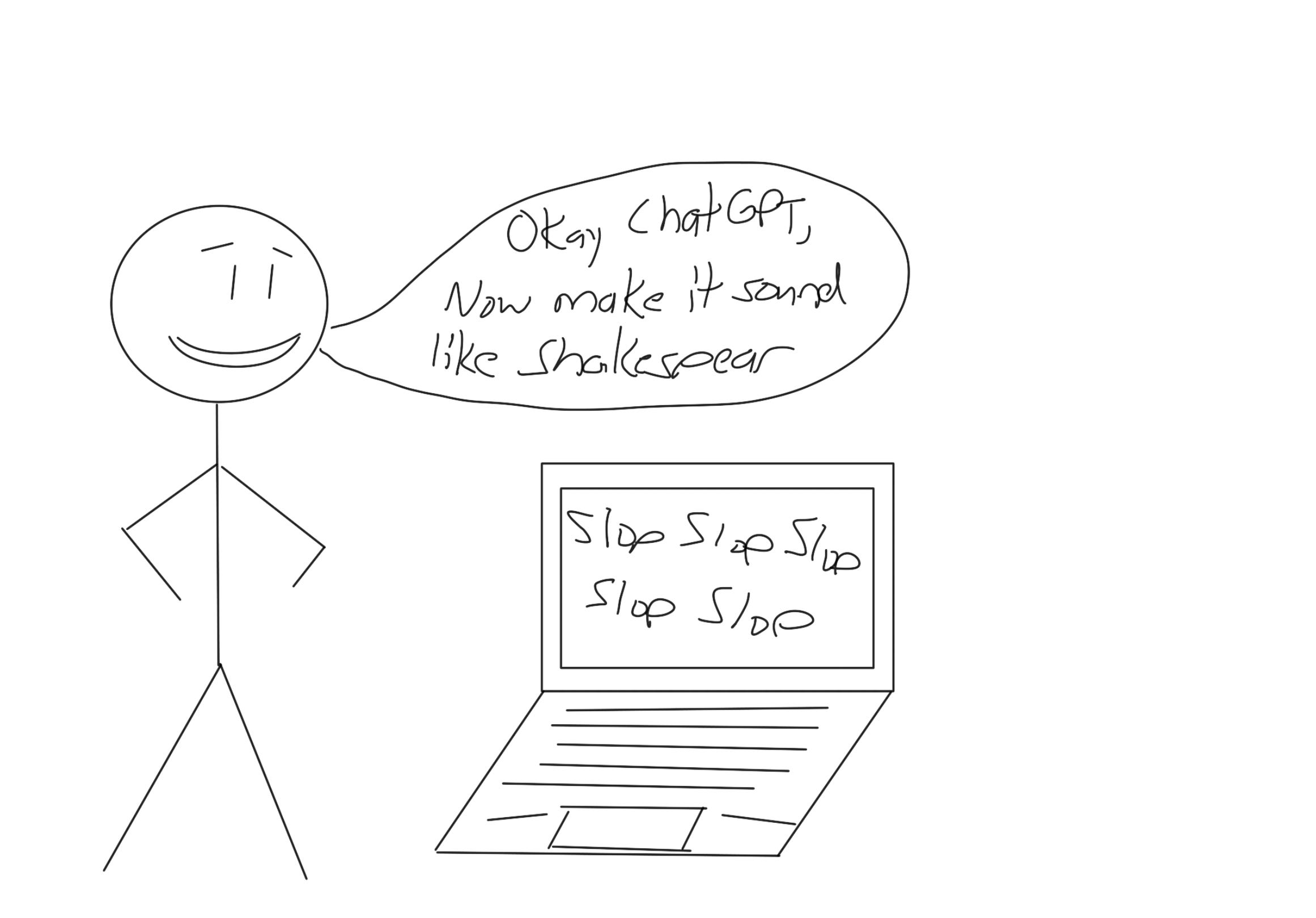
As someone who has written close to a million words online at this point, I have had, from time to time, people ask me, “Do you think AI will kill writing?”
My answer to that is “no,” but AI has killed something else. The previously timeless phenomenon through which the existence of “text” signaled the intellect, understanding, or ideas of the text’s writer to its audience.
RIP written word as a shortcut for assessing someone else’s thoughts: 3,000 BC - 2025.
An example: Twitter was, originally, a place for short-form, 140 (then 280) character posts. Twitter now has an “article” feature, allowing you to publish native blog posts directly on the timeline. One particular group of folks LOVES Twitter articles: the industry I work in: venture capitalists.
Why?
Well, everyone wants to be a self-described thought leader for some mixture of either branding or flaunting their knowledge to the founders they’re trying to court. Which, again, is fine if it’s your knowledge. Union Square Ventures’ founder and general partner Fred Wilson has been writing a blog for decades; it’s textbook VC lore at this point. I have never once doubted whether or not something that Fred wrote was “Fred.” He’s been doing this for decades. I’m sure Fred Wilson would commit seppuku before publishing AI content, or, at least, masquerading AI-generated content as his own thoughts.
But I swear 90% of articles I see on the timeline are just AI slop masquerading as venture capitalists’ “unique insights.” Give me a break.
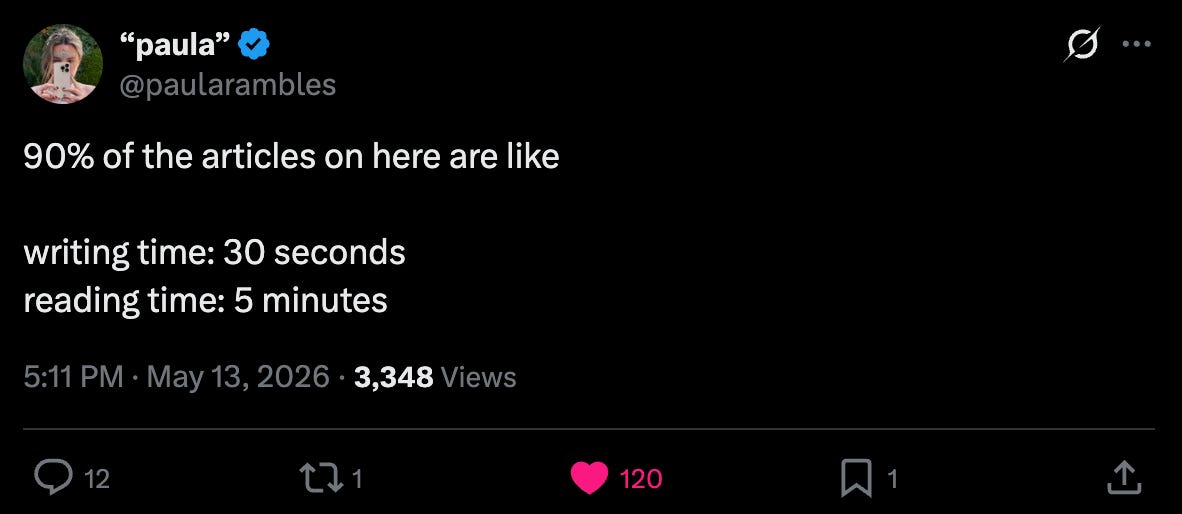
It’s not that all AI content is “bad,” but the misrepresentation of LLM output as one’s original thoughts is intellectually dishonest slop.
I define “slop” as something that takes longer to consume than it took its creator to create.
By definition, “slop” could be a web app, blog post, or YouTube video. The nice thing about slop code, however, is that as long as it “works,” meaning it gives me the correct outputs from the inputs that I give it, it doesn’t really matter. Does knowing how to voice-to-text Claude with “dangerously skip permissions” turned on mean I’m a software engineer? Of course not. My slop code is probably crawling with security lapses, and I wouldn’t trust anything I build to be deployed in an enterprise setting. BUT! It’s quite useful for me and my own workflows, and I don’t try to present myself as some genius for knowing how to tell Claude to do stuff. I’m a proud “slop cannon” building random stuff all week, it’s a huge productivity hack. But I’m not tricking anyone into thinking that I, Jack Raines, am the architect of the software I’m building.
I even list “Claude” as a contributor on my Github repos.
“Slop” writing feels especially egregious given that the act of “writing” is synonymous with ‘thinking.” AI did not change this equation: if you can write well, odds are you can think well. What AI did do, however, was allow folks to masquerade as “writers” when they have slyly hidden “Claude,” their co-author, from the audience’s view. Someone is thinking, but it’s a GPU in Virginia, not you, person “publishing” the idea.
Usually, when I’m reading, and especially if I’m reading someone’s blog, I’m not-so-much reading to learn about “a thing” as much I am to learn about what a particular person thinks about “a thing.” Their perspective and understanding is half of the joy of reading. I don’t want to simply know “thing,” I want to know the writer’s take on “thing.”
With AI, you can no longer assume that what you’re about to read is the brainchild of the article’s byline. And that is quite annoying. One benefit of writing online so publicly since at least 2021 is that I learned how to write. Another benefit, however, is that because I was writing in high volumes pre-ChatGPT, a stranger who finds my page can more safely assume that my writing is “human,” not “AI.”
It’s not that anyone who just starting writing in 2026 has to be using AI, but writing is an inherently difficult thing, and if your public writing output coincided with a magic bot that could write for you, well, that’s convenient. Which sucks for new writers, because it’s that much harder to earn audiences’ trust.
I now put “writers” in two camps: “pre-ChatGPT” and “post-ChatGPT.” Anyone who started their blog or grew their platform prior to ~2024 was probably writing their own content. With anyone who just started in 2025, or especially 2026, you just don’t know. And that’s the issue: you can’t assume a new writer’s work is their work if they don’t have older proofs of work with which you’ve grown accustomed to.
But the bigger problem is that, with AI content exploding in volume, your typical reader isn’t going to take the time to evaluate whether a piece of content is “human” or “AI.” They’ll likely skip it altogether, meaning that slop content is crowding out original thoughts in the marketplace of ideas.
Another interesting “writing” shift caused by AI is the increasing value of brevity. AI loves these long, drawn out explanations. I swear the labs have weighted their models to use as many tokens as possible to boost their revenue numbers. Anyway, because AI loves to ramble, brevity is, I think, an increasingly human trait.
10 years ago, some laborious, long-form, ridiculously dense article might have helped prove your gigabrain IQ to whichever readers managed to survive your 12,000 word monolith.
But now? Just put the prompts in the bag, bro.
Combine our already shrinking attention spans with growing distrust of the purity of anything too long or wordy, and we’re entering an age of more Hemingway, less Dickens.
- Jack
I appreciate reader feedback, so if you enjoyed today’s piece, let me know with a like or comment at the bottom of this page! And make sure to pre-order my first book, Young Money, by clicking below:
fight the slop.
SlopCannon takedown of AI slop is very meta