

Welcome to Young Money! If you’re new here, you can join the tens of thousands of subscribers receiving my essays each week by adding your email below.
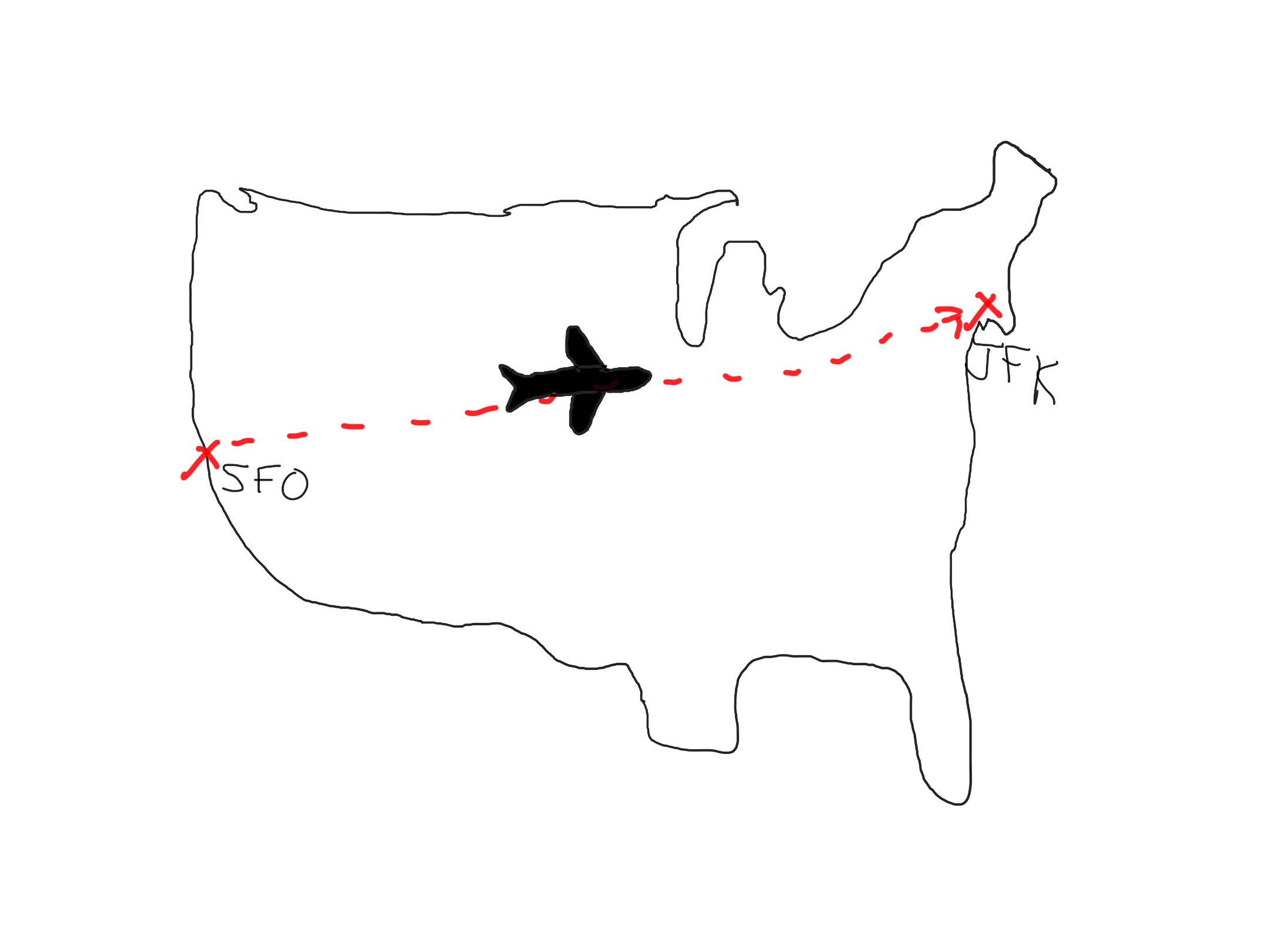
I moved back to New York this weekend. I mean, sort of. I flew a bunch of suitcases to New York on Friday because I’m about to head to a bachelor party in Florida on Thursday, and then I have to immediately turn around for a wedding in India, and then it’s right back to Georgia for the holidays, so I needed all of my stuff on the east coast. So I guess it’s more apt to say I’m “moving” back to New York in January. That sentence makes me quite happy to type out, because I love New York City. Seeing the skyline when I’m flying into JFK or LGA brings a smile to my face.
This may come as a surprise to some people who didn’t realize that I wasn’t living in New York, considering I was in town quite a bit over the last year. According to my mailing address, however, I was living on Lombard Street in San Francisco from February to December.
I initially moved to San Francisco for work when I took a new job at the beginning of the year, and frankly I had no idea what to expect when I arrived. It turns out, I liked San Francisco more than I expected. The Bay area is, to me, the prettiest part of the country. And for someone getting their first reps in the venture capital world, there’s not a better city for speedrunning your exposure to hundreds of startups in a condensed period of time. I also made a lot of new friends in San Francisco in 2025, many of them building a variety of cool, ambitious companies. I took tennis lessons and joined a basketball league for the first time in years, I blared Mistletoe by Justin Bieber on full blast in the back seat of my Waymo on the way to work, and, contrary to the videos I saw floating around Twitter in 2022 and 2023, I didn’t see that many homeless people. San Francisco is a cool city where you can see the future being built real-time.
New York has ten times the population of San Francisco, but San Francisco punches above its weight given the talent density in the tech scene, particularly in AI right now. It is funny how historical precedents tend to repeat themselves over and over and over again. San Francisco was a literal gold rush town in the 1800s, and now it’s a metaphorical gold rush town. The city was left for dead after Covid, then AI happened, and boom, everyone and their mother is raising $10m on uncapped notes to build “AI for dogs.” And an insane amount of money will be made (and incinerated) with this current AI boom.
New York and San Francisco both cater to the same archetype of high-achieving white collar worker who wants to make a lot of money in tech or finance, so naturally, they are compared a lot. “The only serious entrepreneurs start their companies in the Bay; New York has too many distractions.” “Silicon Valley is an echo chamber, New York is the real world.” “Value is created in San Francisco, it’s extracted in New York.” “The main reason to make money in San Francisco is to spend it in New York.”
I don’t have much to add on the culture war between the two cities. My only contribution is that the east coast just feels like home. I like San Francisco a lot. Candidly, I’d rather live there than my first post-college city, Atlanta, but it never quite felt like home. Maybe it’s because I’m originally from Georgia or that I went to grad school in New York, but I felt like a tourist in California. I love travel more than most, but spending too much time as a tourist wears on you, so it’s nice, after a year, to finally feel “home” again.
That being said, I’ll be back in San Francisco every month, because, you know, someone needs to invest in AI for dogs and crash YC’s demo day.
What I’m Working On:
“Finding” founders vs. “finding” creators. I was asked at a holiday party Friday night what I actually do for a living. Apparently “running an etiquette school” was a poor answer. The truth is that early-stage venture capital is a pretty weird job, but it all boils down to “finding compelling people building compelling companies.” The ways in which you do this can vary quite a bit. The thing about “startups” is that both investors and founders know how the song and dance goes. Founder wants to raise money. They build a product, pitch VCs, and say, “We want to raise $5 million at a $25m valuation to build AI for dogs,” and, after a few dozen pitches, a couple of VCs will probably say, “Great, we would like to fund your AI for dogs,” and they sign some documents and collectively own 20% of “AI for Dogs Inc.” There’s also a heavy concentration of founders in San Francisco and New York; the networks are tight-knit.
The creator game is a bit different. While we’re an early-stage venture fund that has been around for ~a decade, earlier this year we raised a separate fund to back creators directly. To us, “creators” are just a subset of founders who happen to have both distribution and community, but they are, at the end of the day, still founders building companies. The difference is in the discoverability. Everyone playing in the traditional venture capital game knows how the fundraising game works at this point, but most creators have never raised money, many have given little thought to what they might do with outside financing, and unlike the startup scene, which is pretty concentrated in SF / NYC, creators live everywhere. The question, then, is how do you get in front of the folks who both 1) want money and 2) have the scale / growth / business model where outside capital makes sense. I’m spending the next week or two kicking around different ideas, but given that many of you are either 1) creators or 2) friends with creators, I’m curious what thoughts y’all have on different locations (whether IRL or digital) that might serve as creator/founder hotspots. And, obviously, if you are one of such creators, hit my line.
What I’m Thinking About:
“We should tax the trillionaires out of existence.” A tweet by Texas state representative James Talarico went viral over the weekend in which the politician played into the well-worn “eat the rich” fervor, this type critiquing Elon Musk’s potential trillion-dollar net worth. A few quotes from the tweet:
“Do we really believe one man is worth more than every elementary school teacher combined?”
“What leads a person to accumulate more money than they could possibly spend in 100 lifetimes when there are people starving in this one?”
“We should tax trillionaires out of existence and use that money to guarantee food, healthcare, and housing for every single American.”
My problem with takes like this from politicians is that, rather than addressing the underlying causes of the issues at hand, they always frame the poverty of some as a consequence of the wealth of others, which, of course, just isn’t true. Wealth is not some “zero-sum” game; in fact, the companies that make their founders billionaires have made plenty of “normal” folks millionaires along the way, because wealth creation is a positive sum game in which anyone with an equity stake benefits. And the whole “tax _____ person out of existence to end _____ societal issue” is just so tiresome.
Hysterically, a few years ago, the UN World Food Program claimed that “2% of Elon Musk’s net worth could cure world hunger,” and Musk tweeted that “If the WFP can describe on this Twitter thread exactly how $6B will solve world hunger, I will sell Tesla stock right now and do it.” Crickets. Poverty is, in fact, a complex issue, and “redistributing money” while ignoring behavioral and environmental factors is a fool’s errand.
The existence of billionaires (and, perhaps one day, trillionaires) is a byproduct of a system that lifts people out of poverty. Those who take on the most risk with new ventures that prove to be quite valuable will make a lot of money if they retain their equity in that venture. And their employees will get rich if they have equity. And consumers benefit from new and cheap and interesting products. Musk could have, and, for his own sanity, perhaps should have, taken his $200 million from the PayPal acquisition and just… chilled. Served on some boards. Instead of rolling the dice on Tesla, SpaceX, and Solar City. Would there be less poverty in America had he not parlayed his money and doubled down? I doubt it. Political vilification of those with more money always strikes me as envy disguised as virtue.
“Narrative, narrative, narrative.” It seems like “head of narrative” is the new hottest job on the market today. Anthropic is offering a $400k base for “head of GTM narrative.” I’ve seen “chief storyteller” thrown around on a few job postings. I’ve even had a few companies hit me up for a few different versions of “will you help me with storytelling?” in the last month or so. I think, on one hand, getting the narrative right is more important than ever, and “story” is something that you can’t just outsource to ChatGPT, because your “story” is a living, breathing organism that must be constantly nurtured. But I also think it’s quite, quite hard to hire a “narrative lead” and force top-down narrative from a new executive position. My $0.02: the ways to really hone in on “narrative development” are 1) hire a consultant that’s really dialed on storytelling and have them coach the founder/CEO on how to sell their story, and 2) have incredibly charismatic sales leads that can paint this same vision to your customers. Founder raises capital, sales team sells product. They’re the ones who need to tell the story.
What denotes “status” in 2026? Being “hot” has been high-status since the inception of the internet, but between Nanobanana (Google’s image model) and GLP-1s, being “hot” (especially online) is now a commodity. Similarly, “travel,” particularly travel to Europe, was a higher-status pursuit in the 20th century when it was less attainable for the masses. Now that the “normal” consumer can afford a summer trip to Rome or Paris, wealthy Americans may as well opt for the Hamptons or Martha’s Vineyard. I’m curious what the next iteration of “status” objects are in 2026 and beyond.
- Jack
I appreciate reader feedback, so if you enjoyed today’s piece, let me know with a like or comment at the bottom of this page!
High status is raising a loving family. In an increasingly artificial world, it’s one of the few things that will always give you real joy. Socialists are basically influencers who weaponize a narrative to steal your money for a destructive anti-creator fund.
I love California and lived in LA for many years, it was great but never home.
As for billionaires and trillionaires I think a lot about who is the best steward of capital. We used to tax the richest at 91%. If the government would use that money to invest in a vital citizenry and economy then I might argue for that. Giving away money can be as hard and complicated as making it. The current wealth imbalance is bad for society in the long run. There doesn’t need to be a full redistribution of wealth to change that but the current situation benefits none in the long run.