

Welcome to Young Money! If you’re new here, you can join the tens of thousands of subscribers receiving my essays each week by adding your email below.
Two quick programming notes:
I wrote a book, Young Money, and it comes out in August. I will, between now and August, marketing this book aggressively, as I would like to sell as many copies as humanly possible. I also think it’s a very good book, you should therefore pre-order it, and you’ll be glad you did. Pre-order link here.
I’m about to start hammering Instagram, because I think it is, at this point, a much stronger distribution mechanism for selling books than Linkedin/Twitter/Substack. Give me a follow here as I try to speedrun this thing to 100k followers.
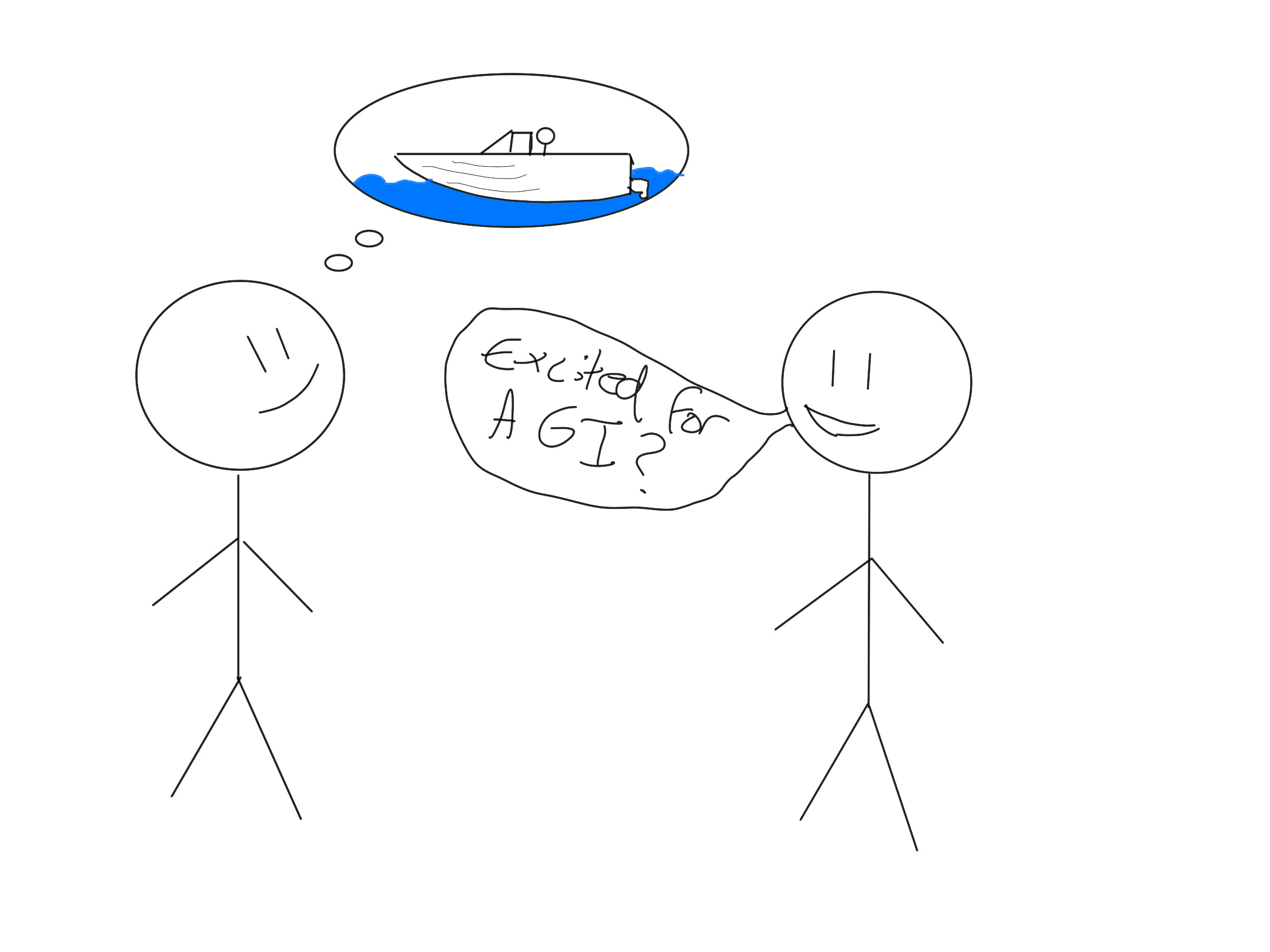
A bit of Jack Raines career history lore here: In fall 2024, I was pounding the pavement applying to different jobs, looking to pivot out of the media space. (for those of you who aren’t aware, I was, at the time, working for Robinhood, helping build out a media business they were incubating).
The first jobs I looked at, one of which I ended up landing and accepting, were in venture capital. But I was, at the time, casting a pretty wide net, which led to me applying to a job at Anthropic as well. For context, in November 2024, Anthropic wasn’t the household name it is today. While it was valued at $18 billion (a very high number for a “startup!”, OpenAI at that point was worth $157 billion, completely valuation-mogging its competitor.
The job I had applied for was part product manager, part product marketing, part comms and narrative: basically helping to shape how Anthropic products and Claude releases showed up in the world. The salary for this job paid something like $175,000 to $200,000, and the equity compensation, at that point, would have probably landed around ~$125,000 per year, or $500,000 total in illiquid stock.
I did not, as you could probably guess, land that job, but if I had landed that job and stayed there for two years, my equity package would be worth quite a lot. Anthropic recently raised funding at a $380 billion valuation, and the company is talking to investors about raising a new round at ~$900 billion this month. For my math wizards, $900 billion is a 50x markup on the $18 billion valuation when I had applied for the job just 18 months ago. $500,000 in equity x 50 = $25 million. Even accounting for dilution in subsequent funding rounds, it’s safe to say that a $500,000 equity package in fall 2024 is worth $15 million or more today, with ~half of that vested. And what about folks who joined earlier, in 2023? They’re likely sitting on $50 or $100 million in unrealized gains as Anthropic looks poised to IPO by the end of the year.
A question worth considering is “what do those employees do next?”
This is a fun hypothetical for me to consider, given that I had applied for a job that would have, in hindsight, made me ~$10 million in vested equity richer in just two years had I been hired.
There is, of course, a subset of folks who do think that “AGI” is real, they are building the machine to end all machines, and we’re only a few months out from “money” losing any real meaning as intelligence becomes both free and commoditized. Many of these folks joined OpenAI or Deepmind in the 2010s, or Anthropic in 2021 and 2022, and, if they’re still working at their AI labs at this point, they are probably working for something more than money. (I personally disagree with the AGI hypothesis, but I also haven’t made $10 million+ from AI equity.)
But most Anthropic (and OpenAI, xAI, etc.) employees are normal, albeit competitive, folks, who, like me in 2024, probably realized that “AI” was going to be the trend that dominated the next 5-10 years, and working for one of the companies at the forefront of AI would have a high likelihood of making them a lot of money. But no one expected everyone to get so rich so fast.
Most equity compensation packages vest over four years. 25% after one year, then monthly vesting for the next 36 months. A lot of 20-somethings took a relatively-high paying job anticipating some level of equity appreciation, but no one saw an $18 billion “startup” jumping to a ~$1 trillion valuation in two years. This level of insane wealth creation in 24 months for a small group of people is unprecedented. So, if you’re an ambitious 29-year-old who finds himself, post-Anthropic IPO, with $14 million liquid, what do you do next?
This is, of course, something that companies think of ahead of time. Public companies (and later-stage private companies) tend to preemptively offer “refreshers” to their top performers, giving them additional equity grants on top of their initial grant to keep them incentivized to work there.
The issue here is that these AI companies’ valuations have jumped so much, so quickly, that the “additional equity” has diminishing marginal utility for most smart-but-not-totally-AGI-pilled folks. If you’ve made $3-4 million in a few years, you’re probably happy but not-at-all ready to retire or jump ship, and you’ll stick around for another $3-4 million in equity grants. But at $15-$20 million, the math changes. You have retirement-level wealth, and even if you don’t “retire” for good, you could certainly afford to take a break for a year or two, particularly when the upside on new equity grants pales in comparison to the 50x spike you had since 2024.
A tweet went viral yesterday where Citadel founder Ken Griffin explained how he admonished a recent Harvard grad who said he’d quit his job to “travel and climb the highest peaks around the work” if he had $10 million liquid tomorrow.
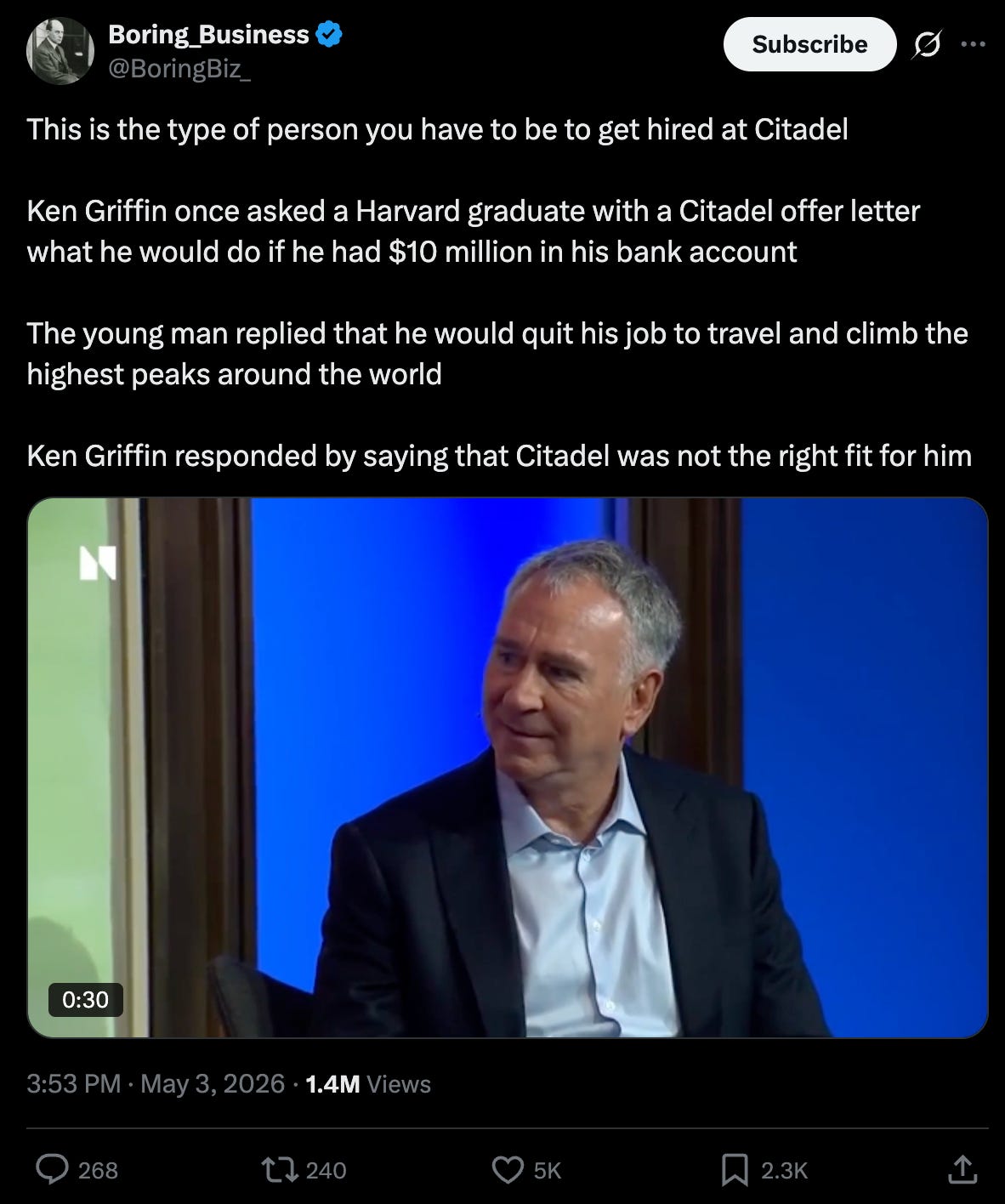
While it’s a stupid interview tactic to tell the billionaire founder of one of the world’s largest hedge funds that you’d say “adios” if you made $10 million, I do think most folks, if they had that level of wealth creation virtually overnight, would consider something similar.
If you joined an AI startup because you really believed that you were building the machine god, then, well, 1) you probably joined quite early, before the economic outcome was obvious, 2) you’re past the point of “money” mattering as you’ve long since become rich, and 3) you are probably motivated by something more than “money” alone. But if you’re a “normal” opportunistic employee who caught the AI wave early, realized it would be the biggest step function change in tech in your early career, and now you’re up $20 million on that bet, well, you probably couldn’t care less about AGI.
But owning a ski house in Jackson sounds pretty nice.
Market pundits have thrown around plenty of concerns that could kill the momentum of the current AI boom: compute crunches, energy costs, data center construction delays, or public backlash (such as everyone on TikTok actually thinking AI is wasting our water supply).
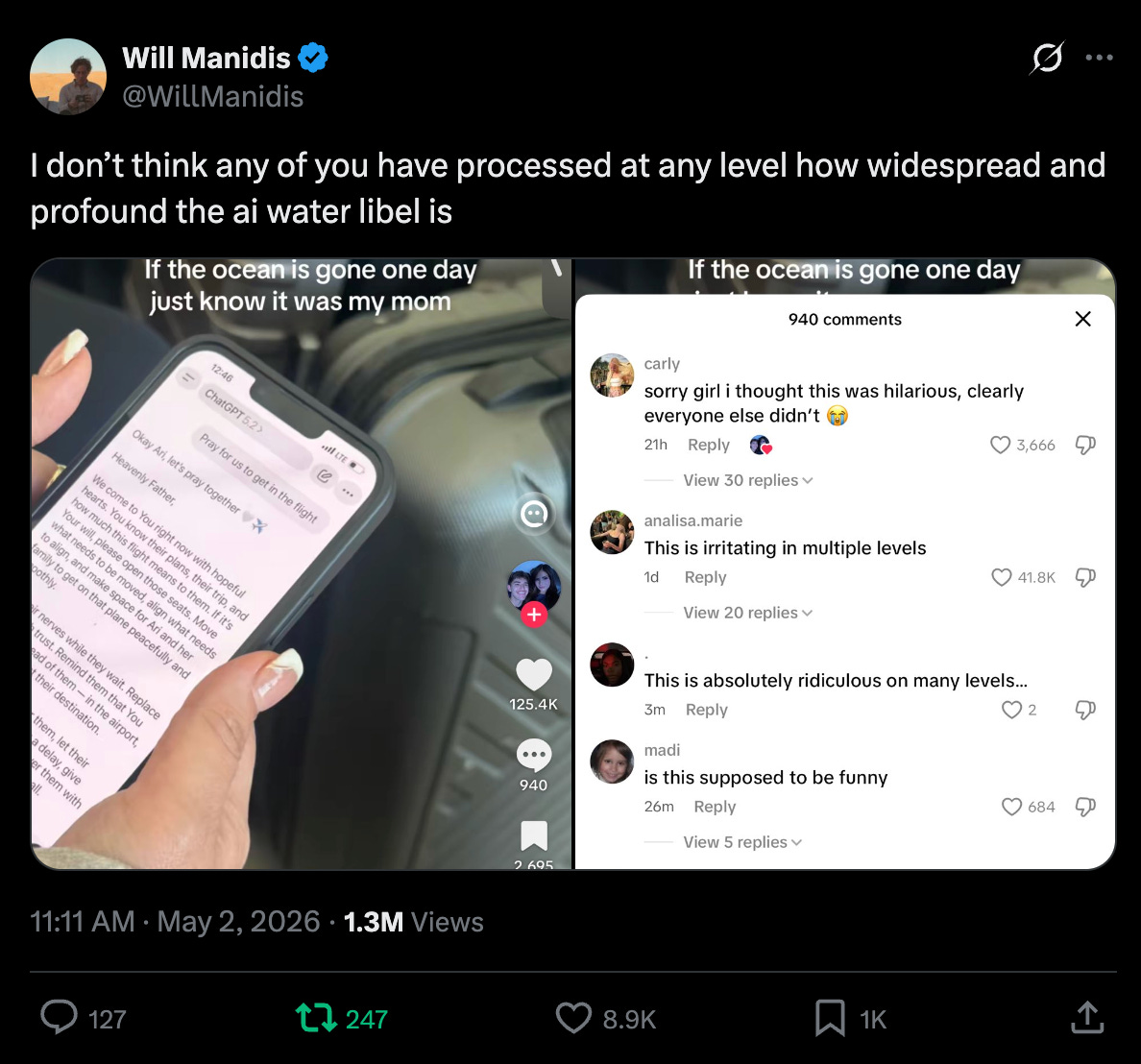
I think the more interesting risk that isn’t talked about enough is “What if all of the employees get too rich too fast?”
Founders and early believers might be motivated by more than money, but plenty of folks joined these companies for, more than anything else, an opportunity to make an ungodly amount of money. And once you make that money, well, it’s a bit tougher to stay motivated, and additional equity compensation just isn’t that appealing when you can afford anything you could possibly want.
Companies are nothing more than collections of people. If those people get too rich too fast, many will be tempted to ring the register and do something else. I’m not predicting the AI bubble to pop anytime soon, but it will be ironic if the thing that “kills” AGI is too many AI employees getting too rich too fast.
Links and Other Thoughts:
Good piece from Baillie Gifford’s Tom Slater on the cognitive impacts of extensive AI usage. The piece raises interesting points on how over reliance on AI weakens our knowledge retention and understanding. I’m also 99% sure this was written with AI, given the flow of the prose, but still an interesting piece.
Situational Awareness Essay: A couple of years ago, former OpenAI researcher Leopold Aschenbrenner wrote a long-but-thoughtful essay on how he saw AI ramping up over the next few years, and he raised a ~$250 million hedge fund to invest in the companies that would benefit accordingly. Situational Awareness has since printed money, now managing a few billion dollars. It’s good to read back over this in 2026 and see how right he was.
This was a great Invest Like the Best interview with the GOAT Paul Tudor Jones. Here’s a fun related “lessons learned” piece from Tren Griffin about what he learned from PTJ as well.
- Jack
I appreciate reader feedback, so if you enjoyed today’s piece, let me know with a like or comment at the bottom of this page! And while you’re here, pre-order your copy of Young Money, too.
Fwiw I think IG is a bit overrated. Newsletters and text social are probably still pretty good. That’s where readers live. Far too much passive scrolling on IG
instagram is reels focused ~ reels viewer = short attention span, X users read articles, will read a book.