

My first book, Young Money: A Field Guide to Wealth and Purpose in Your Twenties, is available everywhere you buy books. I wrote 270 pages on status games, opportunity costs, and the stage-specificity of life; topics that I think are particularly timely today. To catch my next blog post, subscribe to my email list here. For my most detailed thoughts on this topic, order my book below:
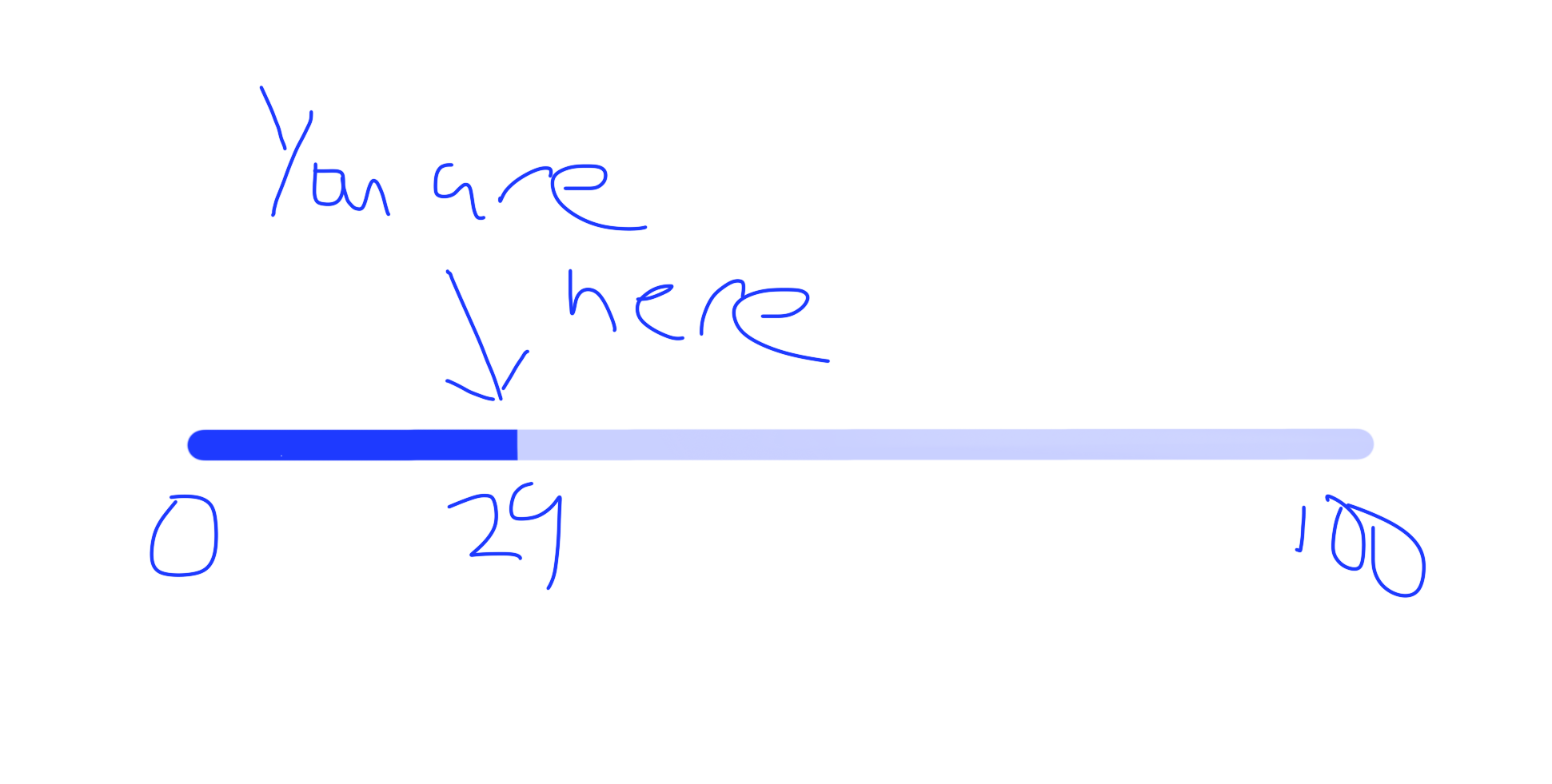
A few years ago, I wrote “25% Loaded” as a series of reflections on my 25th birthday. Today, 2.5 months after my 29th birthday, I would like to return to this theme with “29% Loaded.”
While I share Tim Urban’s disdain for what Buzzfeed (rest in pieces) and its ilk did to the “listicle,” I do still think a tasteful listicle is an efficient and enjoyable format for a “reflections” blog post, so here are 29 beliefs I have now. Some are total reversals from 2022-era Jack, some have only grown more calcified. Feel free to let me know what you love or hate in my inbox or the comment section.
The utility of money depreciates exponentially with age.
One of my favorite metrics is “fun per dollar spent.” When I was 21, I could have the time of my life on $20 and change at karaoke night at my favorite college dive bar: “The Hummingbird.” (Largely thanks to $2 beers, $5 cocktails, and a shared appetite for sophomoric nonsense with my college friends). At 29, the equivalent “fun” on a night out is probably something like $200, adjusted for inflation. NYC is more expensive, I don’t want to go to spend my evenings at a dump surrounded by 21-year-old college students, etc. This, of course, applies to more than just “nights out.” I need a nicer apartment for the same level of “life satisfaction” as I had at 23. I’ll probably never stay in a hostel again. The one exception: Citibikes are the best form of transportation, AND they’re 10x cheaper than Ubers. Transit deflation is a W.
Adulthood “happens” to you faster than expected.
When you’re 22 on the verge of graduating from college, “30” seems like some distant, far-away place. It also sounds like an age at which you’ll be “washed.” Then you blink, and you’re 29, and half of your friends are 30+, and several of those friends, particularly from the south, are married and/or having kids, and you think, “huh, I guess we became adults.” There’s no specific moment in which any one thing changes. It just kind of… happens.
Divergent outcomes become increasingly-common around ~28.
I now have several friends who have, in no particular order, made millions of dollars thanks to joining OpenAI or Anthropic early, had a child with a woman they weren’t married to (whoops!), spiraled into credit card debt and/or are developing gambling addictions, maintained otherwise “normal” careers but feel like they’re falling behind when they compare themselves to the right-tail winners from their social circles, panic-applied to law school or business school, sold businesses for millions of dollars, and failed to sell businesses for millions of dollars. Everyone is on the same “path” through around age 24, but the divergences really begin to materialize as you approach 30.
The biggest crisis of the back half of the 2020s is information overload and attention decay.
My screen time last week was 7 hours and 52 minutes. This number is probably a bit inflated; I usually have my phone unlocked next to my computer during the work day, so I’m not “doomscrolling” for 1/3 of the day, but I probably am spending 4+ hours glancing at my phone, and it wouldn’t surprise me if my numbers are “median” for a white-collar worker. Ever-increasingly-powerful social media algorithms with profit motives + a proliferation of AI-slop content has created a potent environment where our attention jumps from “thing to thing” without us dedicating enough time or focus to fully understand any particular thing. The creates an interesting world where everyone is “informed” but no one “knows” anything.
Optionality is a depreciating asset.
By 29, you start seeing which folks are “stacking” wins. This is particularly evident in folks’ careers and relationships. One particularly interesting phenomenon in the NYC dating scene: a lot of folks are jaded, treating courtship a chore rather than a source of enjoyment or an intentional pursuit (sense of “choredome” is usually a defense mechanism, but I digress). Similarly, a lot of folks have developed a “job-hopping” psyche of sorts, going from “thing to thing” every two years. Meanwhile, the folks who seem the happiest on the relationship front committed to someone and are trending toward marriage (if not already married), and those with the most “success” in their careers made a bet a few years ago that has compounded, rewarding them with either higher salaries or appreciating equity. Of course, to do either requires taking some sort of “risk”. More on this in a moment.
Never pursuing optionality is a recipe for a mid-life crisis.
A caveat on the last point: the folks who I’ve seen spiral the hardest are those who committed to the “wrong thing” way too early. A couple of examples: guy who went to law school immediately out of undergrad, reached 5th year associate level in big law, and is now panicking that he hates the line of work he spent the last 8 years honing. How do you pivot out of the only thing you’ve ever done? It’s hard! Inertia is a powerful drug. Another example: I know more than a few folks who ended 5+ year relationships that started in college around 28 or 29. This is, of course, net “good” in that they at least didn’t marry someone they obviously weren’t psyched to marry, but they also pivot from a half-decade or longer of repetitive monogamy into the post-college dating thunder dome which can be quite unforgiving (or, for some, addicting) to its new entrants. Probably better to try a few different things when you’re young; the stakes are never going to be lower.
Geography is a ridiculously-important factor to well-being.
Having now lived in Atlanta for ~2.5 years, abroad for ~1 year, San Francisco for ~1 year, and New York for ~3 years, I can confidently say I’ve never been happier than I am right now, in large part because of where I’m living right now (NYC). There are a confluence of factors at play, including the fact that a lot of my close friends also live here, but geography is such an underrated aspect of wellbeing, and I think a lot of people discount that to their detriment when considering “upward” career moves. The price tag for a decline in “happiness” should be very, very high.
Perceived risk is usually an exaggeration of realized risk.
Entrepreneurs tend to understand “risk” far better than career “white collar” workers. The latter struggle to fathom how the former can take a bet without any “guaranteed” salary progression or financial outcome, which is, of course, ironic, given that working anywhere is an implied bet on that company and/or industry’s prospects in the medium-to-long-term. Most of what we call “risk” is really “uncertainty,” given that the worst-case-scenario, if plotted out logically, usually just isn’t that bad. Particularly when you’re young. The happiest folks in their late 20s to early 30s figured this out early.
Prestige is a valuable means to an end but a hollow end itself.
The most braindead take on social media in 2026 is that “Ivy League schools no longer matter.” Prestige is the most AI-proof asset in the world, and it’s only growing more valuable. When so many appearances, from product demos to writing samples to resumes and cover letters, can be faked, “proof of prestige” serves as a filter that most folks, from potential employers to potential suitors, will default to. Stacking a few prestige stamps, whether they be good schools, good company logos, or a combination of both, is only going to get more valuable.
But don’t let “prestige” be the end itself, leverage it to do something cooler than gunning for VP at a megacap PE shop.
The dating market inverts in your late 20s.
This one is a bit comical to experience in real-time, but the dating market for a late-20s dude in a large city who somewhat has their shit together is just infinitely better than it is for his 5-years-younger self.
(That’s not to say 24-year-old dudes should buy into some nonsense like “I just need to grind for 5 years before taking dating seriously. Then you’ll just be a maladjusted weirdo who doesn’t understand why no one likes them despite their money).
You have more self-confidence, you’re (hopefully) no longer a kid getting status-mogged by dudes five years your senior, you can actually afford to take a girl out for dinner and couple of drinks without worrying about missing rent, and your “market,” age-wise, is basically early 20s to early 30s. 23-year-old guys are fighting an uphill battle against everyone else their age and guys five years older; it’s admittedly nicer being the guy 5 years older.
Relatedly: has there always been a wave of terminated engagements in one’s late 20s?
Maybe I’m just ignorant and this always happens when you’re 28 or 29, but I know several girls who have called off their engagements in the last 12 months. It’s not surprising to me that girls are the ones calling off their engagements rather than guys (maybe you half-heartedly said “yes” at the moment, and it wasn’t until months later than reality set in and you weren’t excited), but has this always been a thing?
Optimization culture is a total self-own; turn off the devices.
There’s a quote, typically (falsely) attributed to Peter Drucker, that says, “What gets measured gets managed,” which really describes everything wrong with optimization culture today. Imagine if I was, for example, going to grab a few beers with my friends on Saturday afternoon, but my Whoop said that my sleep score was a 42 last night and, oh no, I haven’t hit 10,000 steps today, and, well, how many carbs are in those beers any way? So I instead decided to skip out on any and all social events to reset my health scores?
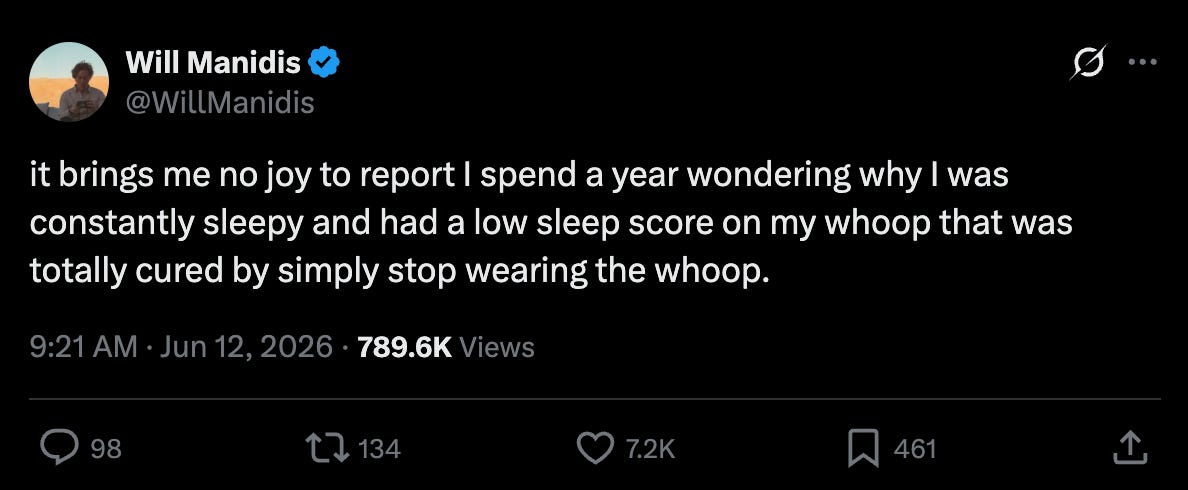
Optimization for the sake of optimization is a stupid pursuit. You’re going to die at some point; don’t be so pretentious about biomarkers.
Writing a book is particularly unique individual struggle (but I’ll probably do it again)
My primary professional goal, since starting this blog in 2021, was to publish a book before turning 30. I’m going to clear that mark by eight months (pre-order your copy here.). From 2021 through ~2024, I romanticized the hell out of “writing a book” for a few reasons: a book has more object permanence than “blogs” or other forms of content, “author” commands more respect than “writer,” and it’s just the aspirational outcome for anyone who decides to share their thoughts online.
What I didn’t realize, until I started working on said book, was 1) just how lonely the book writing process is, and 2) how much of it is really a battle with oneself. “Writing a book” is really “writing at least three books” given the number of rewrites and revisions you’ll do as you inevitably hate the earlier products.
All that being said, I’ll probably do it again in a few years.
Someone stupider than you is going to make a lot of money.
People get rich in all sorts of ways, and it’s impossible to fully separate the role that “luck” and “skill” play said riches. I’m going to define “rich” here as someone who’s made $5m or more by the age of 30. A few examples from folks I know:
Successfully exited a startup where they pocketed $20m+.
Successfully exited a startup where they pocketed $100m+.
Joined Anthropic in 2023.
Joined OpenAI in 2023.
Joined another high-flying startup that has since 10x’d.
Joined a new hedge fund that crushed it on the AI trade.
Bought a shit-ton of Palantir a few years ago (still haven’t sold).
Gamestop in 2020/2021 (sold the top).
Married rich.
Parlayed a few cryptocurrencies.
Nvidia stock.
“AI implementation consulting”.
Ran “rapid Covid testing” shops during the pandemic.
A lot of these people are really smart. All of them, knowingly or not, took on a heightened level of risk in some aspect of their lives. It’s quite easy to look at someone who came into a massive windfall and think, “Why not me?” but you’ll drive yourself insane. Judgement via hindsight is a dangerous game; if you knew the outcomes beforehand, then, yes, obviously you would have made the same decision as them. But we’re all making decisions to the best of our abilities with the information we have at the time. The only real takeaway is outsized returns are downstream of concentrated bets.
Envy is the ugliest human trait.
Related to the last point: “envy” is increasingly common as more folks around you are crowned “winners” in some facet of life, and envy is the most corrosive of human traits if it’s allowed to fester. Envy serves no purpose in closing the gap between you and the target of your envy, it just makes its host resentful. A good litmus test is asking yourself to think about the last three people in your broader social circle who had an outsized win. Where you genuinely happy for them, or did part of you begin comparing yourself to their new standing? Comparison is the thief of joy, and it snowballs into envy rather quickly.
Watching someone materially destroy their life is a sobering experience.
When you’re young, you have a long leash for “do-overs.” The stakes of doing anything at, say, 18, short of killing someone, are pretty low. You can bounce back from early screwups and have an underdog story. After 25, the world is less forgiving. A collection of stories that I’ve witnessed over the last few years from folks that I was, at one point or another, quite close to:
Football coach who had an affair and blew up his marriage.
Serial cheater who blew up a friendship and his own relationship trying to sleep with a friend’s ex.
Substance abuser who ran a red light while inebriated and killed a woman.
Suicide after years of drug addiction.
As well as more than a few folks who have “given” up and are unrecognizable from their early 20s due to apathy and/or weight gain.
While there’s no single way to “win” life, there are a few different ways to “lose.” This game isn’t a spectator sport.
Intuition is underrated.
One problem with the “AI-ification” of everything is that, because we have an abundance of data as well as the ability to quickly gather and process said data, it’s easy to default to “the data” when making decisions. One version of this is health-maxxing to the point that you become a slave to your Whoop’s sleep score, another is failing to “trust your gut” when it comes to careers and relationships.
If it feels like you’re on a plateauing (or sinking!) ship, particularly when you’re young, it’s your responsibility, and yours alone, to take care of yourself and redirect your path. If you wait until the “correct” move is obvious, you’ll be late. If you’re going to panic, panic early. I had this experience in my last job working in a media business before joining Slow. Six months in, both the organization and broader industry didn’t “feel” right to me; it was an intuition thing. I made my mind up and immediately started looking for something else. Current job was a much cleaner fit.
Relationships are the most glaring example of intuition oversight: if your gut says “this isn’t it” 12 months in, you’re not going to “think yourself back into it” a year later. Cut your losses and move on. It’s way too easy to sleepwalk through your 20s.
Related: careers are always, and will always be, a “people” game.
Money is important, but “ability to earn money” matters way more than money itself early in your career. The best way to hone that ability, (and actually enjoy the process) is working for and with folks whom you find aspirational. A good litmus test is whether or not you would want to “be your boss” in 5-10 years. If that picture is more apprehensive than aspirational, then get out. Life is too short to linger around the uninspired.
Sports are the last remaining universal culture phenomena.
The combination of the Knicks winning the NBA championship and the US hosting the World Cup has been a great reminder that, while the internet has become increasingly siloed, sports remain the last bastion of universal culture.
Everyone and their mother was watching Game 5 of the NBA finals two weeks ago, and the footage of Norwegian and Scottish fans drinking New England bars dry has been nothing short of awe-inspiring.
Hangovers at 29 suck but I still think they’re largely mental.
Paul Skallas made an interesting observation a year ago regarding hangovers and stress:
“A few years ago, I noticed that when I was drinking alcohol on vacation. I wouldn’t wake with a hangover. Sure I would be dehydrated or mildly fatigued. But I never had pounding headaches or had to lay in bed the entire day. But that’s what usually happened when I drank alcohol at home, on weekdays or on the weekends. I’d get a headache. So I thought to myself, I think it’s probably stress related to hangovers. Working all day at a stressful job and drinking causes some reaction in my body that doesn’t exist when I’m separated from work and in a completely new environment.”
I’m not going to contest the idea that hangovers do typically get worse with age as your tolerance for alcohol, as well as your body’s ability to “bounce back,” declines. But I do think that increasingly bad hangovers have as much, if not more, to do with the increased stress typical to coming into adulthood than the aging process itself. Put differently, I never felt hungover in the Hamptons last summer a few weeks after finally turning in my book manuscript, but a few beers a month before that had me spiraling.
If you think you have anxiety, you might just drink too much coffee.
I had never suffered from real “anxiety” in my life up until last fall, but around August I was consistently restless and having trouble sleeping, and my mind was racing 24/7. My first thought was, “Do I need a therapist?” My second thought was, “How much caffeine am I consuming each day?” It turns out that, yes, caffeine is indeed a drug, and when I was ripping at least 2-3 “coffee chats” with founders each day in San Francisco, and ordering a caffeinated beverage at each, I was flooding my system with stimulants. Cutting back on coffee consumption was a low-hanging life hack.
Everyone wants the “risk-less” return.
Going back to my earlier points on “envy” and the increasing gap between right-tail winners and everyone else as you get older, an idea that I increasingly believe is that everyone wants the outlier returns but few are willing to tolerate the multi-year period of uncertainty that inevitably precedes said returns. The opportunity cost of “thing that could work,” particularly when it means a pay cut or status hit, is unbearable. Keep that in mind when you see people opting to do something different: it takes balls. I’ll always root for folks willing to tell inertia to kick rocks.
New York City is still the peak of human existence.
My highest conviction belief is that every young person should spend at least two years in New York City before they have kids. Should you stay here forever, maybe not? But it’s really the most high-energy city in America, if not the world (particularly right now). Given that America does run the world, you’re doing yourself a disservice by not spending some time in the heart of the action.
Tech sales is career arbitrage because it feels “low status.”
Most folks, especially the “coastal elite or wanna-be coastal elite striver folks,” that I know quickly select into one of a few career paths: finance (investment banking, PE, hedge funds), big tech, startups, law, or consulting. And even within the big tech and startups crowd, everyone wants to do some form of “business development,” “strategy,” or “product management” because they sound sexy. But if you’re fairly sociable and willing to grind for a few years, you can absolutely print money as an account executive in a fast-growing company. “Sales” is a slur for status chasers, making it a great arbitrage career for folks who would rather make money than say they work in “finance.”
“Travel” as a source of enjoyment has declined with age and the explosion of “content.”
Backpacking Europe and Latin America when I was 24 is, by far, the thing I’m “most glad I did when I was younger but would hate to do now that I’m older.” Part of this is just a natural consequence of growing older, but there’s been a very real shift in the nature of travel tourism as TikTok and Instagram have become more ubiquitous.
Three trends that have diminished travel’s luster since the pandemic: international travel is now broadly accessible, the entire population of the world is on TikTok and Instagram for hours each day, and “hot spots” in different countries now trend 24/7 on these platforms. Everyone wants to visit the same places not for the sake of enjoying the place, but the clout that comes with having traveled to the place, while content creators will do whatever it takes to win the ‘attention game’ while abroad, to the detriment of everyone in their immediate vicinity (blocking sidewalks for street interviews, ring cameras and microphones everywhere, performative posing 24/7.)
The world is increasingly just a stage for the internet. Zuckerberg was right about the Metaverse, he just got the form factor wrong. Life is performed for online perception, and travel has been a casualty.
The bottom 10% dictates society.
Elon Musk has caught a lot of flack for being a trillionaire lately, but I personally have few issues with the “wealth gap” between the uber-wealthy and normal folks. Countless folks now have generational wealth thanks to Tesla and SpaceX’s stock prices, and those stock prices went up because those workers gave us kick ass cars and Wifi on planes that actually works. If you make valuable stuff, reap the rewards.
I posted the below tweet a bit tongue-in-cheek, but I’m a firm believer that the bottom decile of society reduces the median citizen’s quality of life exponentially more than whatever acts of “exploitation” billionaires have subjected me to.
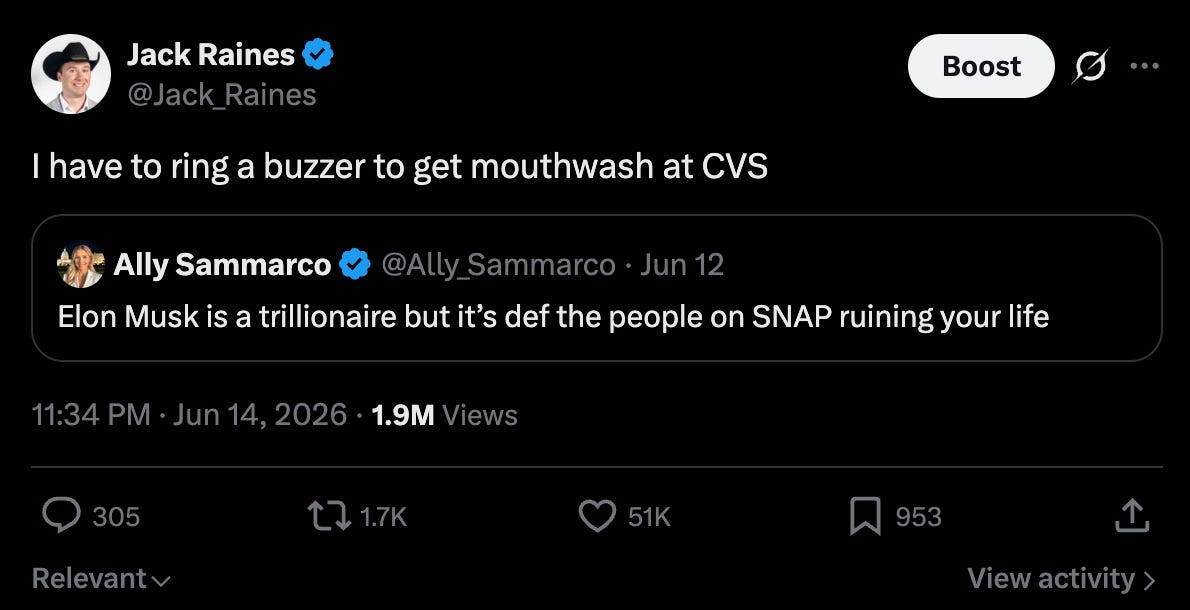
Most rules, norms, and laws that inconvenience or hinder your day-to-day life are consequences of the actions of the bottom 10% (or even bottom 1%), not the top 1%.
1% of the population is responsible for 63% of all violent crime convictions. A few shoplifting incidents are the reason I have to ring a buzzer at CVS to get toothpaste. This applies to all sorts of anti-social behavior, from violence on the subway to open-air drug usage in downtown San Francisco. Too much ink is spilled on redistributing the wealth of the winners; not enough on containing the damage of the losers.
Wit is the most enjoyable trait in new acquaintances.
One of my favorite things about living in New York is that, approximately every three months, I get a text saying, “Hey, my friend __ __ is moving to NYC; y’all should hang.” at which point I immediately make plans to hang. This hang session, beyond me extending a warm welcome to the best city on earth, is also an impromptu interview of sorts where I, and my counterparty, are silently evaluating if this is someone I actually want to hang with.
Dudes with a natural propensity to riff back and forth without hesitation have had a 100% hit rate of being outstanding additions to my social group. Same applies to first dates. This isn’t a particularly novel take, but I do think people felt the need to disguise their wit during “peak woke” a few years back. I’m glad to see humor on an upswing again.
“AI writing” is disrespectful to one’s reader.
No elaboration needed: if you didn’t take the time to write it, and you expect me to read it, consider seppuku? Seriously, publishing AI slop as your own “work” is a middle finger to your reader. Don’t do that. The world needs less content, not more.
Rumination is a mind-killer.
A16z founder Marc Andreessen went viral a few months back for claiming that he has “as little as possible” introspection, claiming that it’s both a waste of time and a distraction from progress. While I respect a hot take, I would like to make an adjustment. Occasional introspection is, I think, both valuable and necessary, otherwise how you do even know what “you” are, or what “you” want? The issue is that introspective people are prone to slip from introspection to rumination, psychoanalyzing every nth detail of a career decision, re-reading old text messages 100 times, or playing out hypothetical scenarios in their mind on repeat for days on end, all while telling themselves they’re “being thoughtful.”
Introspection affirms who you are, rumination disrupts the present with thoughts of an unchangeable past or an unknowable future. The line between the two is thin and, at the margin, I think that minimizing introspection is far healthier (or, at a minimum, likely leads to far more life satisfaction) than spiraling into regular bouts of rumination. But it’s hard to shield yourself from your own mind. So maybe there is some truth to ditching introspection. After all, it’s only the introspective thinker who would take issue with avoiding introspection. Drop the introspection and suddenly you can say, “So what?” and move on with your life.
- Jack
My first book, Young Money: A Field Guide to Wealth and Purpose in Your Twenties, is available everywhere you buy books. I wrote 270 pages on status games, opportunity costs, and the stage-specificity of life; topics that I think are particularly timely today. To catch my next blog post, subscribe to my email list here. For my most detailed thoughts on this topic, order my book below:
Generally good, but the point about the bottom 10% is pretty rough and worth thinking about
If we didn’t live in such an unequal society, would there be as much mouthwash stealing?
Excellent piece. I turned 36 this year and life keeps getting better as you become more confident in your own skin. Enjoy the ride.